Showing posts with label pandemic COVID 19. Show all posts

Tuesday, July 11, 2023

Terminology! The new abnormal (la nouvelle anormalité)

Copyright © Françoise Herrmann

The COVID-19 pandemic and its lockdown ordinances ushered in the term “new normal”, partly in connection to everyone coping with the great online migration. Dramatic changes in the weather are now ushering in yet another expression of life-altering changes: “the new abnormal. 

The National Oceanic and Atmospheric Administration (NOAA) data on US Climate Normals releases updated data every decade, comparing the past 30 years, so that information is provided on weather and precipitation trends on any given day, anywhere in the US. When data was last released, in April 2021, US Climate Normals were already showing a decade warmer than any of the previous ones, and more precipitations everywhere, except in California and the Southwest with dryer weather than ever before. 

Most recently, consider the 490 wildfires that burned across Canada, 110 in the Province of Quebec, devastating a record 30,000 square miles (the size of South Carolina). An extreme weather event with wildfire smoke crossing the border to the Great Lakes, and further east, sending particle-filled air quality to New York City, resulting in never-seen-before orange skies on the East Coast of the United States. Satellite images even showed the Canadian wildfire smoke, crossing the Atlantic Ocean, and blanketing the Iberian peninsula in Europe. At the end of the day, the Canadian wildfires sent 160 million tons of carbon in the air. 

Below, a YouTube video of Justin Trudeau, Canada's Prime Minister, briefing the press, early in the Canadian wildfire events, on June 7, 2023.


Indeed warmer weather brings longer and wider fires. On the West Coast, where wildfires happen often, fires burned more than 4 million acres (an area as large as Connecticut) in 2020, also bringing stay-at-home orders to cities like San Francisco, due to the dangerous smoke-filled air quality.  On at least one day, smoke particles high in the atmosphere even scattered short blue light waves, only letting longer red-orange waves through to the surface, also resulting in eerie, apocalyptic orange skies, through to midday.  

According to EarthJustice—calling urgently for transformative changes from greenhouse-gas-producing energy to clean-energy-production—climate change is playing out just as anticipated in 2006. The year when Al Gore sent out his powerful “Inconvenient Truth” message in an Oscar-winning documentary. Succinctly, in 2023, climate change is already :
  1. Making extreme heat hotter, straining energy and healthcare systems.
  2. Making wildfires burn longer and wilder.
  3. Making hurricanes more intense, as they draw more energy from warmer oceans.
  4. Prolonging and intensifying drought conditions, as water evaporates from water bodies and soil.
  5. Driving increases in precipitation, causing widespread flooding.
  6. Causing rises in sea levels, as oceans warm, and land ice melts, causing more flooding.
  7. Causing stronger winter storms, with heavier snowfall.

Indeed, climate change is already the new abnormal.  According to the NOOA, the United States had already been struck with 12, separate, billion-dollar, extreme weather-related disasters, as of June 2023. 


References

Allan, S. and N. Taylor-Vaisey (July 6, 2023). Literally off the charts: Canada's season sets records–and it's far from over.
https://www.politico.com/news/2023/07/06/canada-fire-season-00104959

Borenstein, S. and M. Walling (June 30, 2023). Climate change keeps making wildfires and smoke worse. Scientists call it the ‘new abnormal’. Associated Press.https://apnews.com/article/wildfire-smoke-canada-climate-change-new-normal-f22a68e7df9688ef8eccd970efde3baf


Gore, A. (2006). An Inconvenient Truth. 

https://youtu.be/mOrHnctozrY 


National Oceanic and Atmospheric Administration (NOAA)
https://www.noaa.gov/


Staff (June 28, 2023). How climate is fueling extreme weather – EarthJustice. 

https://earthjustice.org/feature/how-climate-change-is-fueling-extreme-weather 


Timer, J. (May 4, 2021). The new abnormal is warming up the US government’s climate norms. 

Friday, April 8, 2022

Oh, patents! GEL EXPRESS

Copyright © Françoise Herrmann

Borne out of necessity, within the context of the COVID 19 pandemic, the GEL EXPRESS “totem” station brings mass distribution of sanitizing gel, at warp speed. Indeed, the GEL EXPRESS dispenser not only enables much faster dispensing of sanitizing gel (1000 doses per 5 minutes vs. an average of 60 doses per 5 minutes in conventional dispensers), it also handles much larger  80L reservoirs, dispensing up to 40,000 doses. As a result, the largest 80L GEL EXRESS stations are suitable for high pedestrian traffic at conventions and conferences. The 20L models (see image) are suitable for train stations, or sports stadiums. Whereas the medium 10L models are suitable for small businesses, and the smallest 5L models for buses.

To perform at such speed (1 dose dispensed in .3 seconds), the GEL EXPRESS invention increased both the device’s sensor detection speed and dispensing speed, which in turn increases the number of users, who never have to wait in long lines for sanitizing gel. The device is also contactless, which increases the number of users, otherwise reluctant to use dispensers with push button delivery.

The GEL EXPRESS invention, hailing from France, is recited in the French patent FR3109288A1, titled (in French) Dispositif pour délivrer une dose d’une solution désinfectante, granted on October 22, 2021. The United Nations (UN), World Intellectual Property Organization (WIPO), patent WO2021214021A1, was also granted for this invention. This Patent Cooperation Treaty (PCT) patent provides an official translation (to English) of both the title of the invention Device for delivering a dose of a disinfectant solution, and of the abstract (included below).

The patent recites an automated device comprising a hand reception area, and a sensor able to detect the presence of a user’s hand in the reception area. The device further comprises a hydraulic system with a tank, containing the sanitizing solution, configured to dispense a pressurized dose, when the sensor has detected a hand. The dispensing nozzle is further designed to spray a particular volume of the sanitizing solution. Different sorts of sensors are recited. One preferred sensor is a break-beam sensor, comprising a transmitter and reflecting mirror on each side of the hand reception area, such that when a hand travels in the reception area, it breaks or interrupts transmission of the beam, which triggers the distribution of a dose of sanitizing solution. The beam might be infra-red or visible. Collection means for any unused spray of sanitizing solution are also recited.

The patent Figures 1 and 4 are included, together with an image of the 20L “totem” station (above), installed outdoors.

Specifically, the patent Figure 1 depicts a perspective view of the invention device 1, comprising an upper section 41 and lower section 42, respectively with front surfaces 410 and 420. A middle section 43 connects the upper section 41 to the lower section 42. The middle section 43 is designed to clear the maximum amount of space required for the projection cone 100 of an aerosol dose of sanitizing solution, within a reception area, enabling through-travel of a user's hand. The sanitizing solution is delivered downward, parallel to a Z axis. The user's hand, traveling through the cleared reception area, intercepts the downward flow of the sanitizing aerosol. Hands, belonging to different individuals, travel on different paths that are parallel to the X and axes of a Cartesian plane (designated XOYO and ZO). 

The top down patent Figure 4 shows how individual hands, coming from different directions, might consecutively all intercept the downward flow of a dose of sanitizing solution. Specifically, the Figure 4 depicts extended hands, belonging to three separate individuals, traveling on the path 49, and another individual's extended hand, traveling on the intersecting path 46. The hands travel parallel to the X and Y axes shown. 

The non-obstructed space, within which hands are able to travel, comprises intersecting directions within the open, 250 to 270 degrees angle theta [Ѳ], formed by the intersecting lines 48 and 47, extending from the edges of the middle device section 45, connecting the device top and bottom sections. The two paths shown (46 and 49) intersect under the downward flow of a dose of sanitizing solution.

The abstract of this invention is included below.

A device for delivering a dose of a disinfectant solution (22), characterized in that it comprises: - a receiving zone (Zc4142V1V2) designed to receive a hand (44) of an individual; - a sensor (34) designed to detect the presence of a hand (44) in said receiving zone (Zc4142V1V2), - a hydraulic system (10) comprising a reservoir (11) of said disinfectant solution and configured to distribute a pressurized dose of said solution when the sensor detects the presence of a hand; - a dispensing head (18) for distributing said dose (22) in the form of microdroplets. [English Abstract - WO2021214021A1]


Reference

Monday, November 8, 2021

Terminology - WOTTIES 2021 - "vax" OED Word of the Year

Copyright © Françoise Herrmann

The Oxford English Dictionary (OED) selected the term "vax", short for vaccine, as the 2021 Word Of The Year (WOTY). The term vax not only increased frequency of usage by 72% compared to 2019, vaxxes no doubt saved humanity from extinction during the COVID 19 pandemic. Indeed, as of Nov. 1, 2021, according to the  WHO Dashboardsthe SARS-COV2 pandemic killed almost 5 million people worldwide, including 750,000 in the US alone (NYTimes COVID 19 Maps).

With synonyms  jab, shot or Fauci-Ouchi, the term vax (noun and verb) inflects with a double “ x “ as in “ vaxxed” or “anti-vaxxer”. Neologisms associated with the term include such items as:

  • vaxxie (n): selfie taken while getting a COVID -19 vaccination (Urban Dictionary).
  • vaxinista (n): person who gets the vaccine, and flaunts it with high-end shopping, trips and parties (Urban Dictionary).
  • vax(x)(i)cation (n): after getting vaccinated, vacation taken without wearing a mask in 2021 (Urban Dictionary). 
  • vax-a-thon (n): administration of a record number of jabs at a dedicated event. 
  • vaxxident (n) (unrelated to chewing-gum)post-vaccine automobile accident on roadways, caused by mini-strokes and blood clots in the brain (Urban Dictionary).

On the occasion of the OED WOTY 2021 announcement, Oxford Languages also released a Report into the language of vaccinesOxford Languages claims that "no word better captures the atmosphere of the past year than vax."

 Long live the vax! 


References

BBC News (Nov. 1, 2021).  Vax declared Oxford English Dictionary's word of the year. 
https://www.bbc.com/news/entertainment-arts-59089596

COVID in the US: Latest Maps and Case counts. NYTimes.   https://www.nytimes.com/interactive/2021/us/covid-cases.html

Oxford Languages – Word of the Year 2021: Vax.  https://languages.oup.com/word-of-the-year/2021/

Oxford Languages - A Report into the language of vaccines. https://languages.oup.com/word-of-the-year/2021/ (download link)

Petter, O. (Nov. 1, 2021). ‘Vax’ named Oxford English Dictionary’s word of the year. The Independent. https://www.independent.co.uk/life-style/oxford-english-dictionary-word-vax-b1948929.html

Schuessier, J. (Nov. 1, 2021). Oxford’s 2021 Word of the Year Is a Shot in the Arm. NYTimes.    https://www.nytimes.com/2021/10/31/arts/vax-oxford-word-year.htm

Urban Dictionary  https://www.urbandictionary.com/

WHO Coronavirus (COVID-19)  Dashboards -  https://covid19.who.int/

Monday, June 28, 2021

Terminology - New WHO nomenclature for SARS CoV2 variants of concern and interest

 Copyright © Françoise Herrmann

On February 11th, 2020, the United Nations – World Health Organization [UN-WHO] named the coronavirus disease with emerging pandemic proportions, as well as the virus identified as the cause, respectively Coronavirus Disease 2019 (COVID 19), and Severe Acute Respiratory Syndrome Coronavirus 2 (SARS CoV2) (UN-WHO [1]).  

On May 31st, 2021, the UN-WHO assigned Greek letters to designate SARS CoV2 variants of interest (VoI) and variants of concern (VoC) (UN-WHO [3]). The new WHO labels are intended primarily for non-scientific, policy-making and public use, offering quick, and easy-to-pronounce designations, in a deliberate move to avoid both confusion and stigmatization whether geographical or political. Thus, what was previously referred to as the UK mutation (outside of scientific research), became designated the Alpha variant. Likewise, the previously designated South African, Brazilian and Indian mutations became respectively designated by the Greek letters: Beta, Gamma and Delta.  

The two tables reproduced below, for SARS CoV2  Variants of Concern and Variants of Interest, extracted from UN-WHO tracking of the SARS CoV2 variants, show the scientific names, derived from the use of three different platforms for genetic sequencing, phylogenetic tree visualization and data sharing:  GISAID [1], NextStrain [2] and PANGO [3], together with the new simplified WHO label nomenclature, and date on which the variants were first documented with samples.


UN-WHO - SARS CoV2 variants of concern (VoC) [updated June 15, 2021]


UN-WHO - SARS CoV2 variants of Interest (VoI) [updated June 15, 2021]

The UN-WHO announcement of new labels for SARS CoV2 VoI and VoC clearly states that the Greek lettering does not replace the scientific nomenclatures, derived from use of the various sequencing, and phylogenetic tree visualization and data-sharing platforms, considering the significant information conveyed in the scientific designations (UN-WHO [3]). By contrast, the Greek lettering certainly makes it far easier and less confusing, for the layperson, to refer to Alpha or Beta variants vs. the Pango B.1.1.7 or B.1.351 variants. However, even if language use is known to flow diachronically in the direction of ease and simplicity, it is far less obvious that the new designations of the SARS CoV2 VoI and VoC will flow in abstraction of their geographic locations and origins, outside of scientific research, considering just how important location and origin are to prevention measures and saving lives. Recent articles of the press have already widely adopted the Greek lettering labels, but not by a stretch without origin or location. Most recently, for example, a new, worrisome, Delta variant, has been designated Delta Plus India (Biswas, June 23, 2021, for BBC News).  

The new UN-WHO Greek letter nomenclature for SARS COV2 VoC and VoI overtly seeks to prevent the stigma and potential discrimination of origin and location, which is an undeniably important first line of defense. However, It might take a lot longer, if ever, for the Greek letter designations to acquire meaning, independently of origin and location, assuming also that the pandemic will follow a somewhat predictable course, in 2021, and beyond.

References

Biswas, S. (June 23, 2021). Delta plus India: Scientists say too early to tell risk of Covid-19 variant. BBC News.    https://www.bbc.com/news/world-asia-india-57564560

[1] GISAID https://www.gisaid.org/about-us/mission/

[2] NEXTSTRAIN https://nextstrain.org/

[3] PANGO Lineages https://cov-lineages.org/pangolin.html

[1] UN-WHO  (Feb. 11, 2020).  Naming the coronavirus disease (COVID 19) and the virus that causes it.   https://www.who.int/emergencies/diseases/novel-coronavirus-2019/technical-guidance/naming-the-coronavirus-disease-(covid-2019)-and-the-virus-that-causes-it

[2] UN –WHO – An Update on SARS CoV2 mutations & variants [Jan. 25, 2021 updated].   https://www.who.int/docs/default-source/coronaviruse/risk-comms-updates/update47-sars-cov-2-variants.pdf?sfvrsn=f2180835_4

[3] UN- WHO (May 31, 2021). WHO announces simple, easy-to-say labels for SARS-CoV-2 variants of interest and concern.  https://www.who.int/news/item/31-05-2021-who-announces-simple-easy-to-say-labels-for-sars-cov-2-variants-of-interest-and-concern

[4] UN-WHO Tracking SARS CoV2 variants.  https://www.who.int/en/activities/tracking-SARS-CoV-2-variants/ [Updated June 15, 2021]

Winter, L. (June 1, 2021) WHO updates the nomenclature of SARS-CoV2 variants. The Scientist.     https://www.the-scientist.com/news-opinion/who-updates-the-nomenclature-of-sars-cov-2-variants-68837

Friday, November 27, 2020

Terminology - WOTTIES (1) - Collins Dictionary 2020 Word Of The Year

Copyright © Françoise Herrmann

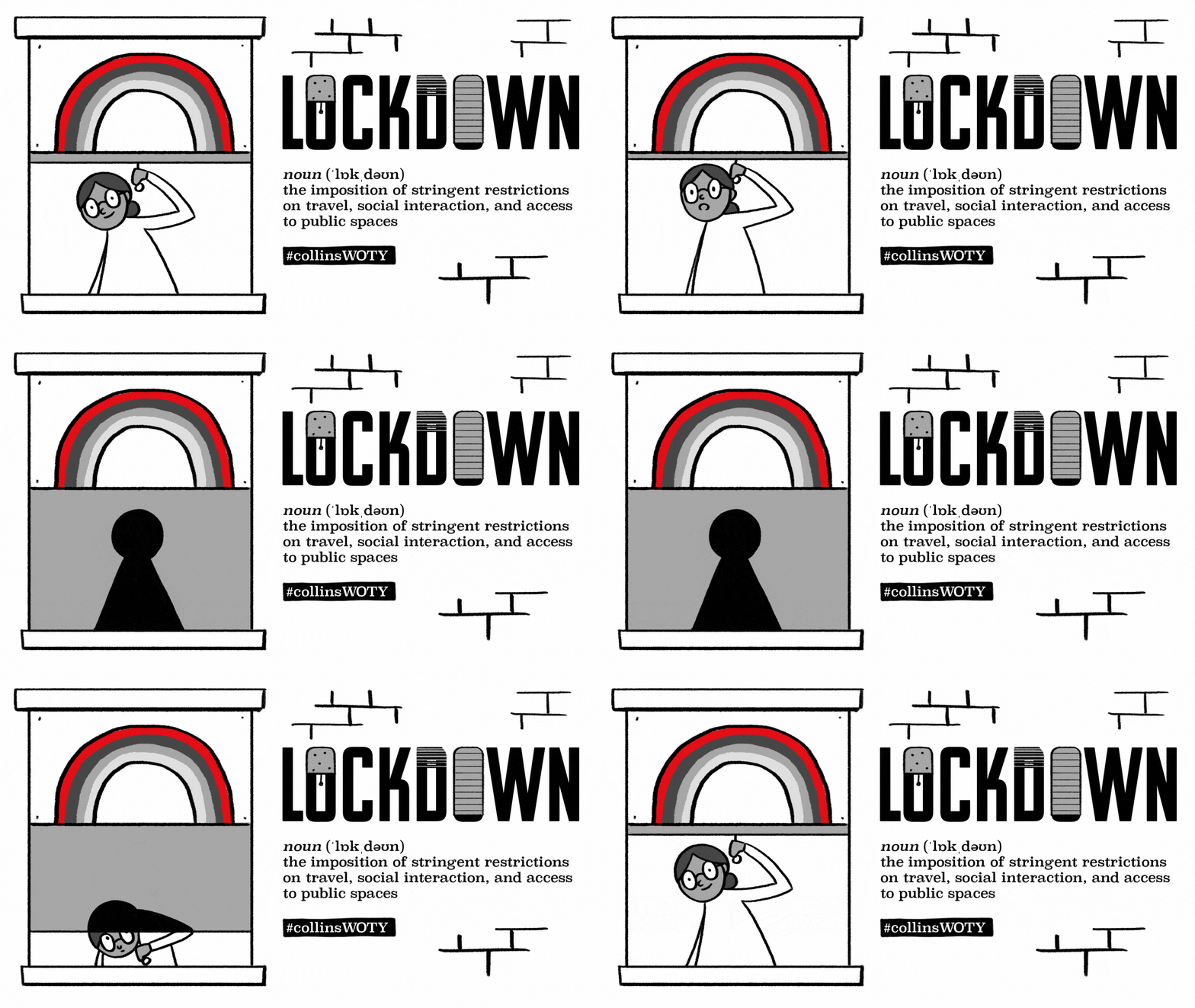
Each year, Collins Dictionary of the English Language selects the Word Of The Year, referred to as the WOTY, an acronym that rhymes with “potty”. The Word Of The Year is selected, based on the significance of the recorded number of searches for a particular term, during the year. Unsurprisingly, this year’s WOTY is pandemic-related. 

Indeed, Collins’ 2020 WOTY is Lockdown, a word that logged more than one quarter-million queries, compared to just 4000, in 2019. A word, according to Shariatmadari, whose usage has also squarely migrated, from the domain of incarceration to public health (Shariatmadari, Nov. 10, 2020).

Collins' 2020 definition of the term lockdown is the following:

Lockdown:  the containment measure implemented by governments around the world to mitigate the spread of COVID-19. 

A second, 2020 definition of the term lockdown appears on the animated GIF for the winning WOTY, imported below, directly from the Collins website.  


References

The Collins Word Of The Year 2020 is ….. https://www.collinsdictionary.com/us/woty  

Shariatmadari, D.  (Nov. 10, 2020) The year of the lockdown Collins Dictionary Language Lover’s Blog. https://blog.collinsdictionary.com/language-lovers/the-year-of-lockdown/