Beginning at NYU in Jan 2013 within the context of a Patents Translation course delivered online, this blog seeks to uncover the patents that rock our daily lives....
The ON CLOUDS GmbH company was founded in 2010, in Zurich, Switzerland, by three former professional athletes: Olivier Bernhard*, David Allemann, and Caspar Coppeti. The brand took off with Roger Federer’s endorsement and co-designer partnership in 2019, then went public on the New York Stock Exchange (ONON) in 2021. However, the story of the brand’s origin is one of a kind.
Indeed, ON running shoes were born of cut garden hose pieces (seen as “clouds”) attached under a sports shoe upper. The garden hose pieces were intended to provide a soft landing—gentle on knees—when compressed under the runner’s repeated impact with the ground. Such garden-hose “clouds” would also provide a hard enough surface to enable propulsion, after compression under impact with the ground. An original idea, cobbled by Oliver Bernhard, that became the brand’s “cushioned landing, powerful takeoff” award-winning** cloud technology.
The US design patent USD804159S, titled Shoe sole, was granted on Dec. 5, 2017 to David Allemann (CH ) and Olivier Bernhard (CH), for the ornamental properties of the ON CLOUDS running shoe sole, modeling the original hose-cloud sole.
Below, the patent Figures 1 and 2 depict, respectively, a bottom plan view and a lateral elevation view of the ON CLOUDS running shoe sole, together with an image of a marketed ON Clouds product.
-------- Notes:
* Swiss Ironman champion.
** ON won the ISPO (Internationale Sponsorenmesse) BrandNew Award in 2010.
During his brief tenure as Creative Director for menswear at the 170-year-old Louis Vuitton (LV) luxury fashion House, Virgil Abloh* had time to introduce skate-style sneakers into the prestigious line of LV shoes. The chunky sneaker, street-skate style, was re-created and expertly tweaked into an iconic LV sneaker. A sneaker that became a permanent staple of the luxury LV product line. Luxury, because each pair of LV sneakers is hand-crafted at the Manufacture de Souliers Louis Vuitton (manufacturing and design center for LV shoes), in Fiesso d'Artico, close to Venice, Italy. A shoe manufacturing process that takes approximately sevenhours to complete for each pair.
Skate-style, as in “skateboard-style”, the board that was originally designed, in the 50s and 60s, for surfers to keep fit and agile on land, during periods when there are no waves to ride in the ocean. A twenty-first-century style that had already transitioned over several decades, from the niche-sport surf-style into a global street-style phenomenon, complete with organized skate competitions, skate music, skate fashion, and insider skate talk (Thimo, 2024). A style that Virgil Abloh had already pioneered in the United States with his own luxury streetwear brand called Off-White™.
The LV street-style sneakers have a patented sole. The US design patent, USD1033004, titled Sole for footwear, was awarded on July 2nd, 2024, to Mathias Patillon and Alexander Kelvy. The patent was then assigned to the original legendary (1854) trunk-making companyLouis Vuitton Malletier (FR).
Below, the patent Figure depicting the patented sole design, from the bottom-up, together with LV Skate and LV Trainer sneakers models, both manufactured with the patented sole design.
-----
Note
* Virgil Abloh, the first black-American Creative Director for Louis Vuitton menswear, from 2018 till his premature death at the age of 41, in 2021.
The US design patents covering the ornamental aspects of the TIEKS™ ballerina flats do not explain why TIEKS™ ballerina flats are so comfortable, practical, and stylish. Such aspects of the TIEKS™ re-invented ballerina flats are the purview the United Nations, World Intellectual Property Organization (WIPO) utility patent WO2013022466A1, titled Split sole footwear.
The WIPO patent recites how TIEKS™ ballerina shoes were invented to reconcile modern women’s shoe dilemmas, such as the tradeoff between comfort and style, or between lightweight portability and support or durability. In other words, the inventors found a need for much improvement in the design of existing foldable-portable ballerina-type shoes. Improvements in terms of being able to use these types of shoes on hard or rugged surfaces, without wearing out the soles, thereby extending their durability and also enhancing both comfort and style. For example, TIEKS™ foldable ballerinas have a greater overall spring constant, preferably comprised between 0.55 kilogram-force/inch and 0.65 kilogram-force/inch, designed to provide more support and comfort for prolonged periods of wear. Using augmented manufacturing processes, such improvements thus informed the re-invention of the TIEKS™ split sole ballerina flats. A ballerina flat where the toe cavity tucks into the heel cavity, when the shoe is folded on an axis running between the two parts of the split sole.
For improved comfort, durability and style, specifically designed to resolve the abovementioned dilemmas, TIEKS™ ballerina flats comprise three soles: the signature, Robin’s egg-blue split sole, comprising a forefoot outsole patch and a heel outsole patch; a midsole stitched to the upper, and a separately inserted insole, with foam inlay, tapered cushioning and arch support, enabling the possibility of further bypassing the elasticized upper rim, around the heel portion, in view of enhancing comfort.
The above patent Figure 6, shows a cross-sectional view of the invention ballerina flat, in an extended state. Figure 6 further depicts a toe portion 70 and a heel portion 68, with a section 32 between the two, enabling the ballerina flat to fold on an axis within the space 32. Below the Figure 6, two additional cross-sectional views, each respectively detailing the sole regions 6A-6A in the toe section 70, and 6B-6B of the heel section 68, indexed in Figure 6.
Specifically, from top to bottom, the Figures 6A and 6B show the insole 30, with an added foam inlay 44, running the full length of the ballerina flat (shown in Figure 6), the midsole 8, and between the midsole 8 and foam inlay 44, on the heel portion 68 of the ballerina flat, a tapered cushion insert 46, designed to further absorb impact when walking on hard surfaces. The cushion insert 46, wedged between the midsole 8 and foam inlay 44, has a maximum thickness of 8 mm, at the one end 78 (indexed in Figure 6), of the heel portion 68, of the ballerina flat. The tapered engineering of the cushion insert 46 provides added lift and comfort, whereas the rigidity of the cushion insert 46 provides added durability. The cushion insert has a Shore A hardness, preferably comprised between 60 and 70, and a density, preferably comprised between 0.50 g/cm3 and 0.70 g/cm3. Finally, the two Figures 6A and 6B, depict the two separate outsole patches 26 and 24 of the split sole, directly interfacing the ground. For added durability, the outsole patches 26 and 24 are designed with grooves (non- depicted), within which to accommodate the seam stitching, and thereby protect the stitching from wear.
The patent also discloses the black drawstring pouch designed for stowing the folded ballerina flats. The signature blue tote for carrying an extra pair of shoes is also recited in this patent.
Below, a YouTube video highlighting a few testimonials in regard to the TIEKS™ re-invented ballerina flats.
Below, the abstract of the TIEKS split sole footwear invention.
A shoe comprising an upper forming an interior portion for a foot, the interior portion including toe and heel cavities, is provided. The shoe further comprises a midsole having toe and heel ends and inner and outer sides. The midsole is stitched to the upper thereby forming a bottom to the interior portion. Heel and toe outsole patches are respectively stitched onto the midsole. An insole is affixed to the bottom of the interior portion. A spacing between the heel and toe outsole patches extends from the inner to the outer side and occupies a position intermediate the toe and heel ends thereby permitting the shoe to fold about an axis running through the spacing. The shoe folds between an extended state, in which the shoe is worn, and a folded state in which a portion of the upper comprising the toe cavity is tucked into the heel cavity. [AbstractWO2013022466A1]
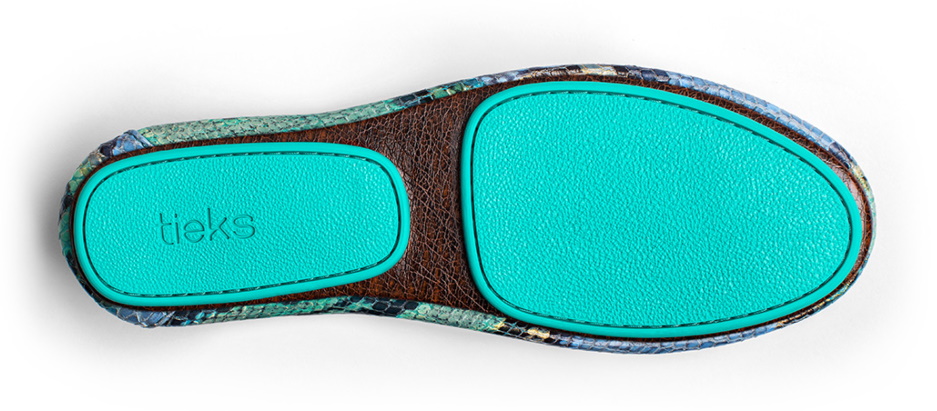
TIEKS'™ signature blue outsole toe patches are patented. The US design patent, USD664755S, titled Toe outsole patches was awarded, on August 7, 2012, to Kfir and Dikla Gavrieli, the inventors and sibling co-founders of TIEKS by Gavrieli. The Robin’s egg blue toe patch is part of the split-sole of the re-invented ballet flats, that fold into a small pouch, while providing the perfect combination of flexibility and cushioning.
The patent coversheet drawing is included below, together with a bottom view image of a TIEKS™ ballerina flat. The selected drawing depicts a bottom view of the toe patch, together with one of the side views. The patent further specifies that the stippling, shown at the tip and upper right corner of the toe patch, depicts surface treatment, occurring on the whole surface of the outsole patch.
A US design patent only covers the ornamental aspects of an invention, or how the invention looks. Thus, the TIEKS™ toe outsole US design patent does not cover any of the comfort or resiliency properties of the invention patches, which are covered in utility patents, together with manufacturing processes.
The TIEKS™ Youtube video shows TIEKS'™ Big comfort, Big performance.
The original OOFos® thong sandal was awarded the US design patent USD621594S1, titled Sandal. The cover sheet patent drawing
is included below, together with an image of one marketed embodiment of the
patented design. As a reminder, a design patent covers only the ornamental
aspects of an invention, or the way the invention looks. Design patents contrast with utility patents, which cover how an invention works, is manufactured, or how the invention might be used.
The patent drawing below depicts lower and upper perspectives of
the sandal. Per the specification of the design patent USD621594S1:
"Straps of the sandal are shown in broken line for illustrative
purposes only and form no part of the claimed design."
Such a recitation gives more scope to the patented sandal design, which can have varying uppers. For example, the subsequent Oofos® slide sandal model, included below the patent drawing, falls within the scope of the patented sandal design, because of its footbed, even though the sandal has a slide upper, different from the broken line thong design of the drawing.
Feel the OO! OOfos®
slides, sandals, clogs, shoes, and boots, are all about foot comfort, especially for
recovery after a hard workout. Indeed, the “O”s of the brand name OOfos® have both onomatopoeic, and visual
significance. An initial “OO” that spells delight, with “O”s yielding into the shape of a
horizontal ellipse, capturing the softness of the footbed, under the impact of each step,
as in the brand name logo:
The OOFos®
invention is recited in the US utility patent application US20190125030A1, titledInsole and outsole two piece shoe. The invention comprises a footbed with two
soles. A footbed, where the outsole does not have to be hard (i.e., >38 on the Asker® Type C
Scale)(1) to absorb impact from the ground and to provide long wear, as in typical shoe design. The two soles of the OOFos® footbed are made of same, or different, proprietary polymeric foam, called OOfoam®, with a hardness ranging from 28 to 38 on the Asker® Type C scale.
Thus, the OOFos® soles, assembled in specific
ratios of thickness, together absorb up
to 37% more impact than other comparable marketed footware (Oofos®, Our Technology). The invention is further
characterized by an upper that is wedged between the two OOFoam® soles.
Finally, the patent also recites the injection molded manufacturing process of the two-piece shoe.
The patent application abstract of the invention is included below, together with the patent
application Figure 1, and an image of a marketed OOFos® shoe. The patent Figure 2
detail, showing how a portion of the shoe upper is wedged between both OOFos® soles, is also
included.
Specifically,
the patent application Figure 1
depicts a front perspective of an embodiment of the invention, comprising a
shoe 10, according to the invention,
an outsole 12, an insole 14 and an upper 16. The forefoot forms a curve between the points 13 and 11. The heel forms a curve between the points 15 and 17. A middle
section extends from point 13 to 15.
Figure 2 is a cross-section of Figure 1, specifically depicting that, at least a portion 18 of the upper 16 is
sandwiched between the outsole 12
and the insole 14.
An article of footwear includes an injection molded outsole of a first material having a durometer reading of at least 28 to at most 38 on the Asker® C scale, an injection molded insole of a second material having a durometer reading of at least 28 to at most 38 on the Asker® C scale, and an upper, at least a section of a peripheral edge of the upper being sandwiched between the insole and the outsole. [Abstract US20190125030A1]
Note
(1) The Asker® Type C scale is a world standard for measuring the hardness of soft rubber.
According to a University of Arizona-Rockport Shoes study cited in the patent US9272058B1, titled Sanitizing device, system and methods of use thereof, the transfer rate of pathogens,
from footwear to uncontaminated surfaces, ranges between 90 and 99% (CIRI, 2001). This means
that such pathogens as Escherichia Coli
(E. Coli), Klebisiella Pneumonia, and Serratia
Ficaria, respectively responsible for extensive gastrointestinal, lung, and kidney damage, might easily be transferred into homes and workplaces simply
when people are walking in (Barker et al. 2001). To resolve
this problematic situation, the invention recited in US9272058B1offers a UV light sanitizing solution. A solution requiring that a user stand on a UV light-emitting platform, for approximately 8
seconds, during which time the UVC radiation
emitted will damage the DNA/RNA of pathogens, in turn making it impossible for any bacteria
and/or viruses transported on the soles of the wearer’s shoes to replicate, and
thus contaminate ambulatory surfaces.
Within the context of the COVID 19 pandemic
and phased re-opening of the economy, this invention has generated renewed
interest at hospitals, restaurants and other community and residential facilities (ABC News, 2020).
The abstract of this invention is
included below, together with the patent Figure
1, showing the UVC radiation-emitting platform, on which the wearer stands
for shoe sole decontamination. This invention is otherwise
versatile, in that the UV light-emitting source also functions as a wand, that might be
removed from the platform box for sanitizing additional objects.
A device that eliminates contaminants before they can be transmitted throughout a structure. The device may include a platform housing a disinfection source for selectively emitting UV-C light. The platform has a top. The top has two areas that pass the UV-C light with the remaining area of the top unable to pass the UV-C light. The two areas of the top are capable of supporting a person standing on the areas with a foot respectively on each area. The disinfection source is configured to emit the UV-C light when a person stands on the two areas, but not when there is no person standing on the two areas. The disinfection source may be removable from the platform for use in disinfecting objects.
In particular, the patent Figure 1 depicts the device 10 comprising a substantially square box housing 12, with four sides 22a, 22b, 24a and 24b, built together to support the weight of a standing adult. The platform 20, on top of the housing 12, has two transparent shoe-print openings 26a and 26b, on which the user stands, and through which UV light is emitted, via a tubular UVC light source 14, for the purposes of sanitizing the user’s soles. The tubular UVC light source 14 may turn on and off automatically, as the user steps on and off the platform 20, so that no UVC light is emitted when noone is standing on the platform 20.
The shoe-print openings 26a and 26b may be of any shape and size, without departing from the scope of the invention. For users with shoe sizes larger than the shoe print, repeat exposures to UVC light are recommended. For users with shoe sizes smaller than the shoe print, the unobstructed effects of any surrounding UVC light radiation are specified insignificant, in terms of potential harm, to the user standing on the device, or to additional people in close proximity.
Otherwise, the housing 12 is substantially hollow, with an opening 28, through which the tubular UVC light source 14 may be removed for use as a portable UVC sanitizing wand 40 (not depicted on Figure 1). The device 10 is powered by regular household current via a power cord 30. The device also has a switch 32, which may include a delay timer for the purposes of giving the user time to step onto the platform 20, prior to activation of the sanitizing UVC light.
Several marketed embodiments of this invention already exist. The YouTube video below demonstrates use of the Healthy Sole Plus System., a system that was laboratory-tested for effectiveness, in March 2020, against both SARS CoV1 and SARS-CoV2 (Sattar, 2020). The Healthy Sole Plus System includes a UV light shield in the toe portion of the platform, as well as onscreen means to assist with correct sole positioning on the platform.
Vionic® is determined to make one to three-inch high-heel shoes, comfortable, painless and safe. The Vionic® high-heel sole invention, targeting this effort, is recited in the US patent application US20180343965A1, titled Footwear and the manufacture thereof.
Indeed, the prior art potential for high heel-related injuries, recited in the patent, appears truly problematic. Consider, for example, metatarsalgia
(inflammation and irritation on the ball of the foot due to altered biomechanics and abnormal weight on
the forefoot), Hallus valgus (also termed bunions), neuromas (nerve damage), in particular,Morton’s neuroma causing toe numbness, in addition to the pain of metatarsalgia, and stress fractures arising from repetitive motion.
To resolve the problematic situations of the prior art, the Vionic® high-heel sole design offers both
biomechanical and support features, intended to:
distribute pressure
from the ground more evenly on the sole of the foot, thereby improving the user’s gait; and
shift some of the weight from toes to heel, thereby reducing forefoot
stress, and improving comfort.
Thus, the Vionic® high-heel soles offer, as shown on the below patent Figure 1, a contoured
heel cup (20), raised arch support (30) attached to the insole board (16), a soft forefoot insert (24), a layer of shock-absorbing foam
liner (28), and a metatarsal pad (17) (beneath the 2nd and 4th
metatarsals), each designed with specific material density, thickness,
angulation, and hardness, measured via durometer on a Shore C scale of hardness.
For example, the metatarsal pad (17) preferably has a 3 mm thickness at the thickest point, a Shore C value of 28 to 32 and chamfered edges [0022]. In contrast, the heel cup (20), is part of the injection molded insole board (16) made of relatively rigid, but still flexible, molded material, such as polypropylene, which is then padded with a gel or soft low-density foam with a Shore C value of 28-32. The forefoot insert (24), also called a "plug" because it fills a hollow area (22) of the injection molded insole board (16), is made of gel or low-density material such as ethyl vinyl acetate (EVA).
The abstract of the high heel Vionic® sole invention is included
below. The exploded patent Figure 1, showing the Vionic® high heel sole
design on a shoe (10),stripped of its side walls and toe-box, with an 80 mm heel (14), andoutsole (12), is included above, together with the image of a marketed
model of Vonic® shoes manufactured with a heel height, corresponding to one of the embodiments of the invention.
An insole board
for a high-heel shoe, said insole board includes a heel supporting area having
a concave heel cup adapted to underlie a heel of the wearer, a medial arch
support area adapted to underlie the arch of the wearer's foot and extending
toeward of but short of the ball of the wearer's foot, and a forefoot area
adapted to underlie the ball of the foot and forefoot of the wearer. The medial
arch support area has a raised contour for supporting a portion of a sole of
the wearer's foot underlying the wearer's arch, and the forefoot support area
includes a hollow having a resiliently deformable material therein. [Abstract US20180343965A1]
Vionic® shoes with orthotic soles, bringing together comfort and
style, are purported to be Oprah Winfrey’s favorite travel shoes!
The Vionic® orthotic sole is recited in the US utility patent
application US20180020772A1, titled Composite orthotic device. The Vionic® orthotic sole is composite because it is composed of an upper cushioning part, designed to engage the user's foot, and a base supporting part, designed to engage
with the ground. Both the upper and base parts of the Vionic® sole are attached
to one another with an adhesive that has a higher melting point than the 90 degrees Centigrade heat
which might be used when the soles are customized and molded to the user’s foot.
The two parts of the Vionic® sole are not only
intended to provide local cushioning and support for the user’s foot, they are most
importantly intended to synergistically provide biomechanical control of the
user’s gait on the entire length of ground surface contact, from heel-strike to
toe-off. Thus, the two parts of the soles are scientifically designed with
varying thickness and angles on the surfaces, as well as varying hardness and
softness, according to pre-determined Shore hardness values, measured via
durometer.
The varying hardness and softness features of the sole are distributed on the
surface according to foot anatomy. Thus, for example, the patent recites in
order of hardness to softness, eight anatomical areas of surface support
[0014-0021], the first metatarsal support portion being the hardest [0014], and
the second metatarsal portion being the softest [0021].
Likewise, the varying angles and thickness of
the sole are distributed relative to foot anatomy, with a molded heel cup, a
longitudinal arch raise and a raised side portion i.e.; “a raised lateral portion positionable adjacent to
the calcaneal cuboid and the 4th/5th metatarsals of the user's foot.” [0047].
The targeted anatomically-defined
sole surface areas are further correlated with an ideal flow path of what is
termed the Centre of Pressure (COP). The flow path of the COP is defined as "the integrated pressure field that the human body exerts on a supporting surface via the foot." [0094]. It corresponds to the
successively timed ground-contact phases of a user's gait cycle (from heel-strike to
toe-off). In turn, this additional mapping of timed contact phases, relative to an ideal
COP flow path, serves to further inform the hardness/softness,
thickness/angulation features of the sole design, for the purposes of coaching and
controlling the user’s gait in an optimal way. It is the COP flow path, driving
design features to control the user’s gait from heel strike to toe-off, that is
at the heart of this invention, relative to prior art soles systems, also seeking
both to support and cushion the user’s foot, and to control the user's gait.
To illustrate the connection between the ideal COP flow path and the various anatomically-based design features of the Vionic® composite sole, previously mentioned, the patent application Figures 17A, 17 and 9 are included above.
Figure 17A shows the ideal COP flow path with the successively timed contact phases of a user’s gait cycle, from heel-strike to toe-off. Figure 17 shows a Vionic orthotic sole with the solid line of the ideal COP flow path, and the five ground contact phases of a gait cycle (on the dotted line), relative to foot motion anatomy, namely: “(i) heel strike, (ii) the initial phase of pronation, (iii) re-supination during mid-stance, (iv) plantarflexion of the 1st ray and Hallux dorsiflexion, and, (v) toe off.” [0094].
Figure 9 shows the keyed thickness/angulation, softness/hardness sections and regions of the sole, correlated to foot anatomy, each of which is intended to coach the user’s gait as closely as possible to the ideal COP flow path. The keyed regions and sections of the Figure 9Vionic® orthotic sole are the following: a lateral heel strike portion(HI); a medial heel strike portion (H2); a Calcaneal Cuboid portion (MI), a medial longitudinal arch portion (M2); a distal lateral forefoot section (FFI); and a first metatarsal portion for the second, third and fourth metatarsal heads (FF2),a second metatarsal portion for the first metatarsal head (FF3) and a forefoot extension (FF4). [0098]
The Vionic® orthotic patent application also recites the preferred materials for the soles,
preferably ethyl vinyl acetate (EVA) for the base portion of the sole, and rebound
EVA for the upper portion, the upper portion being further sheathed in nylon fabric with anti-microbial/anti-bacterial properties. Finally, the patent application also recites the potential customization method for molding one or both Vionic® soles to an individual’s feet, as well as the options for a three-quarter sole or a full-length sole.
The abstract of the Vionic® composite orthotic sole patent application is included below.
A composite orthotic device for use with footwear includes a resiliently deformable base part and a resiliently deformable upper part, forming a plurality of foot supporting portions of differing durometer adapted to guide the wearer's foot along a Center of Pressure path from heel strike to toe-off to follow a biomechanically corrected gait path. [Abstract US20180020772A1]
Easy to kick off your shoes! Much harder to put them back on, handsfree, without lacing or loosening laces, buckling or unbuckling. Even shoes with velcro fasteners require peeling the strips off, and pressing the strips back on. Kizik® shoes offer a handsfree Foot Activated Shoe Technology (FAST) to resolve these problems of the prior art. Indeed, Kizik® shoes just slip on, handsfree, using a titanium spring design. The titanium spring design is attached to the sole and inserted within the upper of the shoe so that it easily compresses when your foot slips in, and pops back up to secure the shoe in place.
This invention is recited in the US patent application US20120317839A1 titled Rapid entry shoe. The patent application, containing 55 figure drawings recites many different embodiments of the invention, according to various shoe styles and functions, including but not limited to “sandals, closed shoes, shoes with varying heights of heels, sports shoes of many types, dress shoes, and the like.”[0029]. The invention uses various movable parts, that move the shoe upper, enabling the user’s foot to just slip in. The many embodiments recited in the patent are repeatedly designated as only illustrative of the invention, whose scope extends to many additional variations of the FAST design.
The abstract of this invention is included below, together with two patent drawings, Figures 43 and 40, each representing a different embodiment of the FAST technology that enables rapid entry into a FAST-fitted shoe. Figure 43 depicts a device comprising a heel loop 104, attached to a hinged rotation axis 80. A lock 114 is included to prevent the loop from collapsing. The device further comprises a stop 120 to prevent the loop from opening past a certain point, a flexible portion 116 and an integral spring 118 to allow the heel loop to move when the lock is released. [0071] Figure 40 also depicts a heel loop 104, attached to a hinged rotation axis 80. However, in this embodiment, a pair of magnets 106, on each side of the loop 104, enable the loop 104 to return to its upright position, after the user’s foot has entered the shoe. [0069]
A rapid-entry shoe allows the shoe to be rapidly entered and readied for wearing by the user. The shoe may be any of a wide variety of shoe types, including shoes of a wide variety of styles and functions. The rapid entry features of the shoes utilize various movable elements that are attached to a sole portion or other portion of the shoe and allow movement of a portion of the shoe under pressure to allow rapid entry of the user's foot into the shoe. The moveable elements may include flexible elements, elements having constructed to have a memory of a native position, magnetic elements, and/or elastic elements. [AbstractUS20120317839A1]