Showing posts with label Lalique. Show all posts

Tuesday, June 11, 2019

More Lalique mascot radiator caps!

Copyright © Françoise Herrmann


Many patented Lalique automobile radiator cap mascots were produced. A sample set of  six Lalique radiator cap mascots is posted below with the original French title of the glass sculpture in parentheses. 

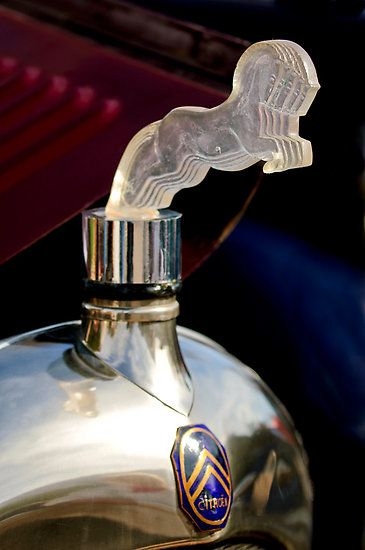
The below set includes: the Citroën-commissioned 5-horsepower mascot (Cinq chevaux), the Delage Spirit of the Wind mascot (Victoire), a Rolls Royce eagle head (Tête d'aigle), the lighted Chrysis nude female (Chrysis), the dancer with raised arms (Danseuse bras levés), and the rooster head (Tête de coq). 


References
Patent FR667900, titled Bouchons lumineux pour radiateurs de voitures automobiles (Lighted caps for automobile radiators)
Lalique Museum
https://www.musee-lalique.com/en
G. G. Weiner (2014) Unique Lalique Mascots: Automotive Radiator Hood Ornaments. Illustrated Edition.  Philadelphia, PA: Trans-Atlantic Publications.

Monday, June 10, 2019

Oh, Lalique! Mascot automobile radiator caps

Copyright © Françoise Herrmann

René Lalique also became renowned for the many various automobile radiator caps (also known as "mascots"), that he designed with glass sculptures in the 1920s. Lalique automobile radiator caps were granted a French patent, but it was not the glass mascot sculptures that were patented. The invention that was patented was the actual metal cap that attaches to the car hood. It contained a socket with a small connected light bulb, which could light up the glass mascot sculpture. 

Thus, Lalique’s radiator caps were awarded the French patent FR667900, titled Bouchons lumineux pour radiateurs de voitures automobiles (Lighted caps for automobile radiators), on July 1, 1929. The title clearly designated the electrical component of the cap, even if the popularity of the caps produced resided in the many Lalique glass mascot variations that adorned the patented radiator caps on automobile hoods.

The patent recites a printed glass-cap subject (1), specifically the “Archer”, and the patented metallic means of attaching both the glass Archer (1) and cap to the automobile radiator, and lighting it. 

The metallic means comprised a cap (14) with a rim (5), connected to an upper cavity designed to house the base (11) of the glass Archer. The base (11) of the Archer was secured to the cap using an appropriate clamping nut (12) and washers (13). A socket (2) equipped with a support (3) for an electric lightbulb (4) extended through the cap, into the radiator, in such a manner that the rimmed cap, together with the socket and lightbulb, remained almost flush with the hood, without increasing the height of the mascot. A contact wire (8) exiting via a small opening (7) above the rim, was connected to the socket contact plate (9), in turn connected to the light bulb contact plate (10). The glass mascot could then be lighted, in several different colors, depending on the color of a base plate (17) placed between the base (11) of the glass mascot and the top of the light bulb. The rimmed cap (14) was screwed to the radiator via threaded sides (6), located beneath the rim (5).

The single keyed patent figure is included below, depicting a vertical sectional elevation of the cap and glass Archer embodiment of the invention. An image of the marketed and signed glass Archer sculpture is also included.


References
Lalique Museum
https://www.musee-lalique.com/en
Lalique website
https://www.lalique.com/en

Friday, June 7, 2019

Oh, Lalique! Decorated glass and crystal

Copyright © Françoise Herrmann

Renowned innovator of Art Deco jewelry, René Lalique (1860-1945) also became a master glassmaker. Initially commissioned to create perfume bottles, he went on to create monumental glass structures such as fountains, church alters, and dining room chandeliers, for example, for such luxury liners as The Normandie. René Lalique even became famous for the car radiator caps that he created out of glass.

To obtain the poetically sculpted glass pieces that are so well known, René Lalique invented a way of producing decorated glass as a single piece using a waste-mold casting process.

The French patent FR475348, titled Procédé de fabrication d’objets en verre ou cristal décoré (Process for the fabrication of decorated glass or crystal objects), granted February 16, 1915, to René Lalique, recites the waste-mold casting process used to create the signature Lalique glass or crystal pieces. A process that enables the production of glass or crystal pieces with ornamental designs that appear sculpted on their surface, displaying all the finest details of the mold. 

The patent recites a process that subsumes the application of wax or wax-type decorations on the glass or crystal surface. The glass or crystal, and its wax decorations are then cast in a mold made of a substance capable of resisting high furnace temperatures, such as a clay or clay-type mold. The clay mold, containing the wax decorated glass or crystal object, is then subjected to high furnace temperatures, causing the wax to volatilize, and the glass to soften sufficiently for it to be blown into the recesses left empty by the volatilized wax. Once cooled, the mold is then broken, and the glass or crystal piece appears with its ornamental decoration, as a single sculpted piece, that includes all the finest details of the mold.

A variation of the process is also described for cases where the ornamental design is very large, and the glass object has a large opening such as a wide-rimmed vase or bowl. In this case, the whole object with the ornamental design is made of wax, then cast in a clay-type mold. The mold is then furnace-heated to the point where the whole wax model with decorations volatilizes. The temperature of the mold is then such that molten glass might be introduced directly into the mold, where it is blown into all the recesses left empty by the volatilized wax model. Finally, once cooled, the mold is broken, and the decorated glass piece appears sculpted with all of its detailed ornaments.

The patent figure 2 is included below, depicting a narrow-rimmed glass or crystal object (1) with ornamental decorations on the surface, within a mold (2). The rim of the glass or crystal object is connected to a cane (3), through which the glass blower will blow to push the softened glass into the ornamental recesses left empty by the volatilized wax, after the mold has been heated in a furnace.

The image of one of René Lalique's famous sculpted vases, called Les Bacchantes, is also included.


References
Musée Lalique
https://www.musee-lalique.com/en
Tuesday, May 28, 2019

Oh, Lalique! L’air du temps

Copyright © Françoise Herrmann

The most famous Nina Riccci perfume of all times is L’air du temps, launched in 1948 by Robert Ricci.

The perfume is famous not only as a fragrance but also because of its bottle, arising out of a collaboration between Marc Lalique, the son of the famous French luxury jeweler and glassmaker René Lalique, and Robert Ricci, Nina Ricci's son, both of whom were childhood friends.

The bottle, crafted by Lalique, has an iconic double dove cap, made of crystal, the glass decorative process of which is patented by René Lalique.

The Lalique Museum in Wingen-sur-Moder, in the northeast of France, has a dedicated exhibit of the bottle.

To date L’air du temps is still marketed with its signature Lalique bottle, and yellow and white packaging, although a limited edition of the bottle was redesigned by Olivia Putman, in 2013, and the graphic design of the packaging has updated through the years.

L’Air du temps is also connected to Andy Warhol who designed New York City department store windows for displaying the perfume. 

Reference
Musee Lalique - L’air du temps 
Nina Ricci