Showing posts with label OXO®. Show all posts

Saturday, August 31, 2019

Oh, patents! OXO® chopper


Copyright © Françoise Herrmann

If you have only a small quantity of vegetables or nuts for chopping, and prefer a bit of mechanical assistance, one of the hand-operated OXO® choppers might be in your stars.

This particular OXO® chopper chops directly on the cutting board, or on the base plate of its own removable food container. The Youtube OXO® manufacturer video below will give you a glimpse of how this handy little utensil works.  


This OXO® chopper invention is disclosed in the US utility patent US7152821B2, titled Chopper. The patent discloses a reciprocating hand-operated food chopper. The chopper comprises a housing, designed to confine the food to be chopped by a vertical reciprocating chopping blade. The blade is attached to a vertical reciprocating plunger assembly, spring-loaded in the raised position. The plunger assembly has an indexing mechanism enabling the blade to rotate a bit, each time the plunger moves up and down, and thus to comminute, or divide, food into increasingly smaller particles  

The OXO® invention offers to improve on the prior art of reciprocating hand-operated choppers by providing a bumper system within the plunger assembly both to enhance the user’s comfort of chopping hard food on a hard surface, and to prevent vibration from causing damage to the blade assembly. Additionally, the OXO® invention offers a stripper system designed to prevent chopped food from entering inside the blade assembly. Finally, the OXO® chopper invention is designed both for easy manufacturing at a cost-efficient price, and easy cleaning as it is effortlessly disassembled/reassembled and dishwasher-safe.

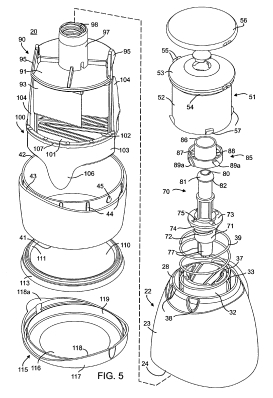
The abstract of the OXO® chopper invention is included below together with the patent Figure 5, showing an exploded view of the chopper 20. The dotted lines connecting both sides of the drawing indicate how the components on the left side of the chopper are assembled beneath those on the right side. An image of the marketed assembled OXO® chopper is included, next to the patent drawing.

On the right side of Figure 5, the exploded drawing shows, among many components of the invention, the plunger 51 with soft grip knob 56, the shaft 70 and indexer sleeve 85. On the left side of Figure 5, the exploded drawing shows, among many additional invention parts, the blade assembly 90 with serpentine blade 93, the blade stripper assembly 100 with scraper extension 106, and the lower body food container with removable base plate 110, enabling to chop on a cutting board, and cap 115, beneath the base plate 110, used for storage.

 A food chopper includes a housing for receiving a food item, a blade assembly including a blade movable within the housing for chopping the food item, a shaft attached to the blade assembly for movement therewith, a plunger assembly coupled to the shaft for effecting, reciprocating, and rotational movement thereof, and a shock absorber disposed between the plunger assembly and the shaft. The shaft is threadedly connected to the blade assembly. The chopper may include a stripper fixed to the housing and responsive to movement of the blade assembly for removing food from the blade, and first and second guide structures respectively on the blade assembly and the stripper for guiding coupling of a blade assembly to the stripper.                    [Abstract US7152821B2]
Reference
OXO® website
www.oxo.com

Friday, August 23, 2019

Oh, patents! OXO® salad spinner brake


Copyright © Françoise Herrmann

Do you have an OXO® salad spinner to dry lettuce or other sorts of leafy vegetables that you have just washed? An OXO® salad spinner equipped with a plunger that you use to actuate the spinning, so that the rotational force of the basket will separate the water from the leafy vegetables to dry them. Do you use the small button on one side of the plunger to stop the salad spinner from spinning?   


This small button, on one side of the plunger, is an OXO® patented brake mechanism designed to interrupt the spinning, so that you can remove the contents of the salad spinner without having to wait until the spinning stops, or otherwise having to open the spinner to manually to stop the inside basket from spinning.

The OXO® salad spinner brake mechanism is recited in a family of 10 patents that includes the US patent US8539693 (B2), titled Brake mechanism for a device for drying foods and other items, and the PCT patent  WO2012134694 (A1) with the same title.

The invention recited comprises a button, actuating a brake caliper mechanism, accommodated inside the spinner’s cover, cooperating with the lid of the salad basket, inside the spinner. When the button is pressed on the cover of the spinner, the brake’s two calipers (designated 'pinching arms') clamp down on the spinning annular ridge of the lid of the salad basket. Since the lid is engaged with the rotating basket, actuation of the calipers that clamp onto the lid, also effectively stops the basket from spinning.  

The abstract of the OXO® salad spinner brake invention is included below, together with the patent drawings Figures 1 and 6. 

Figure 1 shows a salad spinner 20B of the prior art, where the inventive brake mechanism 300 is accommodated inside the cover 24A of the salad spinner 20B.  Figure 6 shows a detailed cross-sectional view of the button-actuated brake mechanism 400, depressed in braking position, with the clamping arm assembly (calipers) 440, clamped down on the outer edges 496 and 498 of the spinning ridge 494 of the salad basket lid 28B

An OXO® manufacturer’s video of the salad spinner in action is also included above.
A brake assembly for reducing the rotational velocity the spinning basket of a food spinning device applies a frictional force to an annular ridge on the lid of the spinning basket. A brake button movably disposed in a cover of the spinning device includes flexible pinching arms having cam surfaces. The cam surfaces of the flexible pinching arms extend through a guide aperture, thereby causing the pinching arms to flex toward each other when the brake button is depressed and to apply the frictional engagement to the annular ridge. [Abstract US8539693 (B2)]
Reference
OXO website
www.oxo.com 

Sunday, August 18, 2019

Oh, patents! OXO® egg poacher

Copyright © Françoise Herrmann

The OXO® egg poacher is a personal favorite – not the thief or bra(s)connier (en français) - just the humble cooking device.


Like no other egg poacher on the market, the hourglass-shaped design of the OXO® egg poacher is intended to poach eggs in direct contact with water, once the raw egg is cracked open. A poaching process that responds to certain disadvantages of the prior egg-poaching art where raw eggs are poached on contact with the cooking surface of various prior art poachers. The resulting OXO®- poached eggs are truly poached as they remain in direct contact with water during cooking. As a result,  OXO® poached eggs retain a much softer texture conferred on direct contact with cooking fluids, without disintegrating. The OXO® egg poacher is further made of collapsible, yolk-colored (Pantone 140864 TXP) silicone for easy stacking, cleaning and handling.

Recently patented, in May 2019, the OXO® egg poacher invention is disclosed in the US utility patent US10278412B2, titled Egg poacher. A patent assigned to Helen of Troy (Nasdaq: HELE), the global consumer products company that acquired OXO® in 2004.

The patent discloses a flexible single-piece, hourglass-shaped, body with an upper and lower portion, communicating via an aperture in between. The food item (i.e. a cracked raw egg), received in the upper funnel-shaped cup portion of the OXO® egg poacher then travels through the aperture to the lower simmering portion of the OXO® egg poacher, resting on the floor of the cooking vessel. The lower portion contains at least one or a plurality of openings, preventing the device from floating, as the openings enable the cooking fluid flow into the lower portion. The cooking fluid thus comes in direct contact with the raw egg, which has fallen through the aperture from the upper funnel-shaped cup to the lower simmering portion of the OXO® egg poacher, where the egg will be contained for cooking. 
  
The abstract of the invention is included below together with the patent Figures  2 and 9, respectively showing a top view of a preferred embodiment of the OXO® egg poacher and a part of the exemplary method of using the OXO® poacher. An image of the striking marketed OXO® egg poacher is also included above.


Figure 2 shows the OXO® egg poacher cooking device 100, comprising a body 102, an upper funnel-shaped portion 104, a lower portion 106 and an aperture 110  between 104 and 106 at the base 126 and 122 of the upper portion 104, enabling the raw egg to travel from the upper to the lower portions of the OXO® egg poacher. Figure 2 also shows the plurality of perforations 112 on the lower portion 106 of the OXO® egg poacher, through which the cooking fluid flows for poaching the egg in direct contact, and which also function to keep the cooking device submerged. Figure 2 further shows an engagement tab 132, allowing the user to grasp the egg poacher; the optimal fill line 172 of the cooking fluid for setting or slightly pre-cooking the raw egg; the peripheral support rim or lip 162 at the bottom of the lower portion 106 that will contact the floor of the cooking vessel. The inner wall 124, of the upper portion 104, extends to the base 122 and 126 of the funnel-shaped cup 104, surrounding the aperture 110, while the inner surface 136 of the inner wall 124 is described as smooth, enabling the raw egg to slide through the aperture 110.


Figure 9 specifically depicts the poaching egg 116, with its egg yolk 182 wrapped in the egg white 180, having fallen through the aperture 110, of sufficient diameter to keep the egg yolk wrapped, while slowing the descent of the egg into the simmering lower portion 106 of the egg poacher, thereby also preventing disintegration.  Figure 9 further depicts the water level 170 at the fill line 172 for slightly pre-cooking the raw egg; the supporting rim 162 at the base of the lower portion 106, in contact with the floor of the cooking vessel 160; the outer sidewall 120 of the upper portion, and the outer sidewall 140 of the lower portion, forming a single piece. The opening 128 of the upper funnel-shaped cup 104, and the opening 148 of the inverted lower portion 106, define approximately equal volumes for each portion (104 and 106) of the egg poacher.
A cooking device suitable for cooking an associated food item includes a body including an upper portion, a lower portion, and an aperture between the upper and lower portions. Each of the upper and lower portions is configured to receive the associated food item and the aperture adapted to allow the associated food item to travel from the upper portion to the lower portion. The lower portion has at least one opening arranged to allow an associated cooking fluid to flow into the lower portion allowing the lower portion in use to become at least partially submerged in the associated cooking fluid. [Abstract US10278412B2]
References
Helen of Troy (website)
OXO (website)
www.oxo.com
Pantone (website)

Friday, August 16, 2019

Oh, patents! OXO® Mixing bowl


Copyright © Françoise Herrmann

The iconic OXO® Mixing bowl that will not slip and is easy to grip, was awarded the US utility patent US5419454, titled Mixing bowl.

The OXO® mixing bowl invention arises as an improvement in mixing bowls. In particular,  the invention addresses the issue of kitchen bowls skidding on a work surface when the contents are mixed, or in general when the bowl is tilted for mixing purposes. The handle design of the OXO® mixing bowls  also offers a solution that prevents users from having to insert their thumb or fingers inside the mixing bowl cavity for the purposes of holding or titling the bowls.

Thus, the patent discloses an inner and outer bowl shell, where the outer shell, positioned on the lower outer surface of the inner shell, is made out of relatively high friction material, preventing the bowl from slipping on a contact surface. The relatively high friction material is rubber-like. In particular, the rubber-like material is made of Santoprene. A special crescent-shaped handle, the top part of which forms a single piece with the inner shell,  is designed to facilitate lifting and grasping the bowl, while preventing thumb and fingers from being placed within the bowl. 

The handle is ergonomically designed with a top part that is convex, and a bottom part that is concave. The bottom recessed part is designed to receive fingers whereas the top convex part is designed to receive the user’s thumb. The easy-grasp handle thus facilitates single hand titling and lifting of the bowl, whereas the bi-lateral symmetrical design of the handle enables both left- or right-hand tilting and lifting. The OXO® mixing bowl is further designed with a pouring spout opposite the handle. Finally, the particular position of the handle additionally enables easy nesting of the bowls (see stack of OXO® bowls below).

The abstract of the OXO® mixing bowl invention is included below, together with the patent drawing Figure 1, and the image of a stack of marketed OXO® mixing bowls. Figure 1 shows the mixing bowl 10, with its inner shell 11 made of hard plastic, base 12, rim 17, and outer shell 20, made of rubber-like material on the lower portion of the outer surface 19 of the inner shell 11. The outer shell 20 extends to up to the peripheral shoulder 18 on the upper outer surface 16 of the inner shell 11.  The lower outer surface 19 of the inner shell is recessed to accommodate the outer rubber-like shell 20.

Figure 1 also shows the upper (top view) section 31 of the crescent-shaped handle 30, opposite the spout 29, the top section 31 of the handle 30  forming a single piece with the inner shell 11. The top section of the handle has two substantially convex portions 33 and 34, intersecting on an arcuate ridge 35. The convex portion 34 slopes down, away from the inside peripheral wall 15 of the inner bowl shell 11, whereas the convex portion 33 slopes down, towards the inside peripheral wall 15 of the inner bowl shell 11.

A mixing bowl has a unitary inner shell including a circular base and a peripheral side wall extending upwardly therefrom to an upper peripheral rim defIning the open mouth of the bowl, the side wall having a spout at one side thereof and, diametrically opposite thereto, a laterally outwardly extending two-part handle, including an upper part unitary with the inner shell of the bowl and a lower part fIxed thereto. The handle has a compound upper surface and a recessed lower surface to facilitate grasping. The base and the lower portion of the peripheral side wall have the outer surfaces thereof covered with an outer shell of frictional material. [Abstract US5419454]
Reference
OXO® website

Wednesday, August 14, 2019

Oh, patents! OXO® Good Grips


Copyright © Françoise Herrmann

Are there any OXO® utensils in your kitchen? The OXO® tools with their easy-grip rubber handles were borne of the pain of arthritis, even if their use is also more comfortable for people without special needs. According to Wilson (2018), the first OXO® hit product, launched in 1990, a vegetable swivel peeler with easy-grip handle, entered the MOMA permanent design collection in 2004. Almost 30 years later, this invention is still gathering accolades, in particular, the Fast Company 2018 Timeless Design, Innovation by Design, Award.  

Beyond the essential necessity of restoring user comfort and capacity, the OXO® Good Grips product line was inspired by the rubber and fins on bike handlebars as a solution for adapting to any hand-held tool or utensil with a core shank.  Add to this winning design solution, the OXO® brand name that can be read forward, backward or upside down, not to mention what it also connotes when you are signing off messages to your close friends and family, and little else should surprise you.

The OXO® grip invention was first recited in the US utility patent US4974286, titled Universal handle for hand-held implement, granted on December 4, 1990. The patent was subsequently amended and corrected, in the reissue patent USRE34194E, granted on March 16, 1993. The patent discloses an invention in the domain of human factors and ergonomic engineering, in response to the specific needs of individuals who cannot firmly grasp handles, whether the handles are for kettles, ladles, potato peelers, bottle openers, spatulas, pot brushes, cheese knives, garden tools, hammers, screwdrivers or any other tool or utensil. Thus, the invention offers a solution termed universal since it is designed to make all handheld implements and tools graspable by individuals who otherwise cannot grip conventional handles.

In particular, the patent recites a stocky handle with an elliptical crosssection, made of elastomeric material with good insulation and cushioning properties. The stocky handle further comprises a hollow internal cavity designed to “socket” the utensil’s core shank. The elastomeric material further comprises strategically-positioned depressable concave areas with which users can engage with forefinger and thumb, in view of strengthening their grip (see figure 7). The concave depressable areas are filled with an array of evenly spaced flexible fins. The elastomeric material of the handle is made out of, for example, neoprene or synthetic rubber. The wide contours of the handle generally conform to the palm of a hand forming a fist, especially if the user is unable to form a tight fist, due to arthritis or other disability.

The abstract of this invention is included below, together with Figures 2 and 7, extracted from the patent, and an image of the marketed OXO® dish or pot brush. 

Figure 2 depicts an embodiment of the universal handle 10 implemented on a pot brush. The pot brush comprises bristle clusters 11 anchored in a base with an extension arm 13. The extension arm 13 is connected to the head 14 of a core shank 15, socketed inside the universal handle 10. The upper end of the universal handle 10 further comprises opposing concave areas 18A and 18B, each with an anchored array of evenly spaced fins 19 that are very flexible. At the lower end of the universal handle 10, an opening 17 makes it possible to suspend the pot brush.

Figure 7 depicts the universal handle 10 nested in the palm of a user’s hand 20, whose fingers 21, 22 and 23 appear clenched around the handle. The user’s forefinger 24 and thumb 25 are respectively engaged with the concave areas 18A and 18B, each comprising evenly spaced fins 19,  at the upper end of the universal handle. The opening at the lower end of the handle 10, designed suspend the tool, is also visible. 


A universal handle for household and other hand-held implements, the handle being adapted to ergonomically render the implement to which it is applied useable by individuals who have difficulty in firmly grasping a conventional handle. The universal handle, which is fabricated of elastomeric material having good thermal insulation and cushioning properties, includes an internal cavity to socket the core shank of the implement. The handle has an elliptical cross-section, the opposing sides of the handle adjacent its upper end each having a concave depression, in each of which an array of spaced, flexible fins is anchored to define a depressible grip site. When the fingers of a user's hand are clenched about the handle, the internal region of the resultant fist conforms to the form of the handle to provide a good grip thereon, the thumb and forefinger pressing into the grip sites to enhance the user's grip on the handle. [Abstract USRE34194E]
References
Fast Company Innovation by Design Awards
OXO® (website)
USPTO MREP - 1401 Reissue [R-08.2017]