Beginning at NYU in Jan 2013 within the context of a Patents Translation course delivered online, this blog seeks to uncover the patents that rock our daily lives....
UPSIDE Foods Inc has just received Food and Drug Administration (FDA) clearance for the marketing of lab-grown meat. In a nutshell, this means the availability of real chicken (and in the future, beef, porc, or duck), grown from animal cells in a laboratory, without hurting, force-feeding, or slaughtering animals.
The UPSIDE Foods Inc website makes it all sound very easy. Primary cells from a chicken, or fertilized egg, are sampled. Ideal cells for establishing a commercial cell line are selected. The cells are nourished with a proprietary cell-culture medium. Then, the cells are cultivated, in a cultivator, at the right temperature and oxygen levels. About three weeks later, the cultivated tissue is harvested from the cultivator, and any leftover cell medium is removed. Currently, the resulting tissue is chicken muscle. In the future, the harvested tissue might be beef, duck, or porc, each product ready to be “inspected, prepared, packed, served, and enjoyed”.
Indeed, the fabrication process even appears easier than the problem of scaling production for mass consumption. At the end of the day, many people, not necessarily vegetarians, are eagerly waiting for 100% real meat that is also 100% cruelty-free (i.e.; does not involve killing any animals).
UPSIDE Foods Inc meat is a patented invention. At least three patent applications recite the UPSIDE Foods Inc cultivated meat invention, each patent awarded to groups of scientists at UPSIDE Foods Inc:
Le Bread Xpress robotic-bakery vending machine was awarded the US design patent USD674020S, titledVending machine. As a reminder the difference between utility and design patents is explained in the following provisions of the United States Patent and TradeMark Office (USPTO) Manual of Patent Examing Procedure (MPEP):
“a “utility patent” protects the way an article is used and works (35 U.S.C. 101), while a "design patent" protects the way an article looks (35 U.S.C. 171). [USPTO - MPEP]
Below, the Figure 1 drawing, extracted from the US design patent USD674020S, together with an image of the marketed, robotic-bakery, vending machine.
The franchised, award-winning, robotic-bakery vending machines deliver piping hot and crusty, artisan-made baguettes, on-demand, 24/7. In France the Panivending machines are found in under-served rural areas, and just outside artisan bakery shops, in view of extending hours of operation. In the US, pandemic-interrupted deployment of the machines was planned for malls and at corporate centers.
At the intersection of hi-tech robotics and artisan
manufacturing, Le Bread Xpress is a robotic bakery vending machine that serves hot,
fresh-baked, artisan-made baguettes, 24/7— just like an ATM machine. As a
bonus for pandemic times, sales of the fresh-baked artisan-made baguettes are
100% contactless. Just swipe your credit card, and watch for when your baguette
comes out crunchy and piping hot, 20 seconds later. Le Bread Xpress is a vending machine
that has automated the fridge-to-oven-to-sale and delivery process for artisan-made
baguettes. Artisan-made baguettes, just like the ones made-in-France, that are pre-cooked,
and refrigerated inside the vending machine. The result is a crispy hot
baguette, available on-demand, or until out of batches, at selected public
locations, and at many private corporate locations.
The robotic bakery vending machine was invented by two French engineers: Jean-Louis and Jean-Claude Hecht. Designated micro-bakery, the robotic vending machine was awarded the President of
the Republic Prize, representing top honors at
the prestigious, 120-year old, 2014 Concours Lépine, an international competition for patented
inventions, held every year in Paris, since 1901. The robotic bakery vending machine was then
marketed as a franchise.
In France, the
24/7 micro-bakery vending machine is marketed by Le Panivending. A company,
selling the micro-bakery vending machines directly
to artisan bakers. Artisan bakers who want to extend the business hours of their shops, and/or
their distribution networks to otherwise under-served locations in small rural
villages—without sacrificing the quality of their artisan baguettes. In the USA,
the franchise Le Bread Xpress is based
in San Francisco, California. Le Bread Xpress delivers hot and crunchy, artisan-made baguettes, in malls,
using Le Bread Xpress micro-bakery vending machine, as well as a large
selection of fresh-baked goods, such as croissants, quiches, pizza, and gourmet
sandwiches, using another micro-bakery vending machine, called the Bake Xpress,
also within the scope of the invention.
The micro-bakery vending machine was patented in France in the below-listed two French (FR) patents. The
patent families include European (EP), US, and Spain (SP) patents, also listed below.
FR2973789-
Dispositif de stockage et de prélèvement et procédé pour l'utilisation d'un tel
dispositif
EP2508450A1- Storage and retrieval device and
method for using such a device
ES2481916T3 - Dispositivo de almacenamiento y
recuperación y procedimiento para la utilización de tal dispositivo
The two
patent families each recite different aspects of the robotic processes. In particular, the two
patents respectively recite: the loading and unloading processes of the bread within the machine (FR2971122), and the conveyor belt system, inside and outside of the oven (FR2973789). The inventions
are best illustrated in the following
Youtube technical video, posted by one of the inventors.
In a
nutshell, the micro-bakery machine stores 120 baguettes in a fridge. 14 baguettes
are kept warm in a compartment for swift on-demand delivery, together with a paper bag. When
one baguette is sold, it is replaced with a freshly baked baguette. The oven is
able to bake eight baguettes at a time. It is the smallest micro-bakery fabricated. The interface is cloud-based, allowing remote access for tracking, and monitoring, of the machine's inventory.
Below, a video of le Bread Xpress at the San Francisco, Stonestown Galleria shopping Mall, showing both the inside and outside operation of the robotic bakery vending machine.
Recognizing that Earth Day is every day, EarthDay.org organized three days of action, centered on Climate Change, to celebrate Earth Day 2021, under the trademarked theme Restore our Earth™.
The
EarthDay.orgRestore our Earth™ theme
regroups 5 major campaigns:
1.The Canopy Project™: Conservation and restoration project that involves planting trees around the
world. Since its inception, in 2010, the
Canopy Project™ project has planted tens of millions of trees, in partnership
with reforestation groups, in areas impacted by climate change and degradation,
or to prevent environmental disasters.
2.Food and environment: Project designed to fight climate change with diet changes. Measures “foodprints”, the environmental impacts associated with “growing,
producing, transporting, and storing of our food— from the natural resources
consumed, to the pollution produced, to the greenhouse gases emitted.”
3.The Great Global Cleanup™: Project
designed to encourage people to “sign
up, show up and clean up ” for
organized cleanup events. The facts on global waste are chilling: 270,000 premature
deaths related to uncontrolled burning of household waste, 1 billion people
live without waste collection services, and 79% of all plastic ever produced have
accumulated in the environment, unprocessed and unrecycled.
4.Climate and environmental literacy: Combined with civic education, the EarthDay.org climate and environmental literacy campaign is designed to create
jobs, build a green consumer market, and enable citizens to find local solutions
to climate change. Launched in 2020, this campaign aims to combine grassroots and
civil society efforts with institutional ones, via a strong civic education
component in all schools.
5.Global Earth Challenge™: Citizen
science initiative, this program is designed to engage millions of people, while
integrating billions of data points from new and ongoing citizen science
projects. Currently, a very large bee
campaign is underway, designed to understand the impact of climate change on disappearing
bee colonies. A mobile app, Global Earth Challenge ™, helps citizens everywhere
to design projects, and share data, for the purposes of informing policy at
local, regional, and institutional levels.
Do you have an OXO® salad
spinner to dry lettuce or other sorts of leafy vegetables that you have just
washed? An OXO® salad spinner
equipped with a plunger that you use to actuate the spinning, so that the
rotational force of the basket will separate the water from the leafy
vegetables to dry them. Do you use the small button on one side of the plunger
to stop the salad spinner from spinning?
This small button, on one side of the plunger, is an OXO® patented brake mechanism designed to
interrupt the spinning, so that you can remove the contents of the salad spinner
without having to wait until the spinning stops, or otherwise having to open the
spinner to manually to stop the inside basket from spinning.
The OXO® salad spinner
brake mechanism is recited in a family of 10 patents that includesthe US patent US8539693 (B2), titled Brake mechanism for a device for drying
foods and other items, and the PCT patent WO2012134694 (A1) with the same title.
The invention recited comprises a button, actuating a brake caliper mechanism, accommodated
inside the spinner’s cover, cooperating with the lid of the salad basket, inside the spinner. When the button is pressed on the cover of the spinner, the brake’s two calipers (designated 'pinching arms') clamp down on the spinning annular ridge of the lid of the salad basket. Since the
lid is engaged with the rotating basket, actuation of the calipers that clamp
onto the lid, also effectively stops the basket from spinning.
The abstract of the OXO®
salad spinner brake invention is included below, together with the patent
drawings Figures 1 and 6.
Figure 1 shows a salad spinner 20B of the prior art, where the inventive brake mechanism 300 is accommodated inside the cover 24A of the salad spinner 20B. Figure 6 shows a detailed cross-sectional view of the button-actuated brake mechanism 400, depressedin braking position, with the clamping arm assembly (calipers) 440, clamped down on the outer edges 496 and 498 of the spinning ridge 494 of the salad basket lid 28B.
An OXO® manufacturer’s video
of the salad spinner in action is also included above.
A brake assembly for reducing the rotational
velocity the spinning basket of a food spinning device applies a frictional
force to an annular ridge on the lid of the spinning basket. A brake button
movably disposed in a cover of the spinning device includes flexible pinching
arms having cam surfaces. The cam surfaces of the flexible pinching arms extend
through a guide aperture, thereby causing the pinching arms to flex toward each
other when the brake button is depressed and to apply the frictional engagement
to the annular ridge. [Abstract US8539693 (B2)]
The OXO® egg poacher is a personal favorite
– not the thief or bra(s)connier (en français) - just the humble cooking device.
Like no other egg poacher on the market,
the hourglass-shaped design of the OXO® egg poacher is intended to poach eggs
in direct contact with water, once the raw egg is cracked open. A poaching
process that responds to certain disadvantages of the prior egg-poaching art where
raw eggs are poached on contact with the cooking surface of variousprior art poachers. The resulting OXO®-
poached eggs are truly poached as they
remain in direct contact with water during cooking. As a result,OXO® poached eggs retain a much softer
texture conferred on direct contact with cooking fluids, without disintegrating. The OXO® egg poacher is further made of collapsible, yolk-colored (Pantone 140864 TXP) silicone for easy stacking, cleaning
and handling.
Recently patented, in May 2019, the OXO® egg poacher invention is disclosed in the US utility patentUS10278412B2, titled Egg poacher. A patent assigned to Helen of Troy (Nasdaq: HELE), the global consumer products company that acquired OXO®
in 2004.
The patent discloses a flexible single-piece,
hourglass-shaped, body with an upper and lower portion, communicating via an
aperture in between. The food item (i.e. a cracked raw egg), received in the
upper funnel-shaped cup portion of the OXO® egg poacher then travels through
the aperture to the lower simmering portion of the OXO® egg poacher,
resting on the floor of the cooking vessel. The lower portion contains at least
one or a plurality of openings, preventing the device from floating, as the openings enable the cooking fluid flow into the lower portion. The cooking fluid thus
comes in direct contact with the raw egg, which has fallen through the aperture
from the upper funnel-shaped cup to the lower simmering portion of the OXO® egg
poacher, where the egg will be contained for cooking.
The abstract of the invention is included
below together with the patent Figures 2 and 9, respectively showing a
top view of a preferred embodiment of the OXO® egg poacher and a part of the exemplary
method of using the OXO® poacher.An image of the striking marketed OXO® egg poacher is also included above.
Figure
2 shows the OXO® egg poacher cooking device 100, comprising a body 102, an upper funnel-shaped portion 104, a lower portion 106 and an aperture 110 between 104
and 106 at the base 126 and 122 of the upper portion 104, enabling the
raw egg to travel from the upper to the lower portions of the OXO® egg poacher. Figure
2 also shows the plurality of perforations 112 on the lower portion 106 of the OXO® egg poacher, through which the cooking fluid flows for poaching the egg in direct contact, and which also function to keep the cooking device submerged. Figure
2 further shows an engagement tab 132,
allowing the user to grasp the egg poacher; the optimal fill line 172 of the cooking fluid for setting or
slightly pre-cooking the raw egg; the peripheral support rim or lip 162 at the bottom of the lower portion 106 that will contact the floor
of the cooking vessel. The inner wall 124,
of the upper portion 104, extends to the base 122 and 126 of the funnel-shaped cup 104, surrounding the aperture 110, while the
inner surface 136 of the inner wall 124 is described as smooth, enabling the raw egg to slide through
the aperture 110.
Figure
9 specifically depicts the poaching egg 116, with its egg yolk 182
wrapped in the egg white 180, having
fallen through the aperture 110, of
sufficient diameter to keep the egg yolk wrapped, while slowing the descent of
the egg into the simmering lower portion 106 of the egg poacher, thereby also
preventing disintegration. Figure 9 further depicts the water
level 170 at the fill line 172 for slightly pre-cooking the raw
egg; the supportingrim 162 at the base of the lower portion 106, in contact with the floor of the
cooking vessel 160; the outer sidewall 120 of the upper portion, and the outer sidewall 140 of the lower portion,
forming a single piece. The opening 128 of the upper funnel-shaped cup 104, and
the opening 148 of the inverted
lower portion 106,define approximately
equal volumes for each portion (104
and 106) of the egg poacher.
A cooking device suitable for cooking an
associated food item includes a body including an upper portion, a lower
portion, and an aperture between the upper and lower portions. Each of the
upper and lower portions is configured to receive the associated food item and
the aperture adapted to allow the associated food item to travel from the upper
portion to the lower portion. The lower portion has at least one opening
arranged to allow an associated cooking fluid to flow into the lower portion
allowing the lower portion in use to become at least partially submerged in the
associated cooking fluid. [Abstract US10278412B2]
Keep your typically unrefrigerated produce, such as tomatoes or
bananas, fresher, for longer periods of time, on the countertop. Rubbermaid®
Freshworks™ containers are designed to regulate the flow of oxygen and CO2, in
and out of the container, using a patented venting system in the lid, and by raising the produce from the bottom of the container, on a Crisptray, which
promotes airflow and prevents spoilage. The lid filter is also designed to last
a lifetime. In other words, it never has to be changed.
Time Magazine-selected as one of the best 50 inventions
in 2018, Rubbermaid® Freshworks™ is an invention disclosed in the US patent
application US20190084756A1,
titledContainer with gas and/or liquid permeable membrane, filed earlier
this year.
The application discloses a container with an upper lid portion and a lower
container portion. The lower portion is the receptacle portion for storage of
fruits or vegetables. The lower portion comprises legs to elevate the container above
the countertop or other surfaces, allowing airflow, and preventing any transfer of
heat from the countertop or surface to the fruits or vegetables stored inside
the container. The legs are also designed to facilitate stacking of the containers, one on top of the other, while providing airflow between stacked containers. The bottom
interior surface of the container is dimpled, in such a way that any moisture arising from condensation is collected in the “valleys” between raised dimples, while the fruits and vegetables sit on the dimple “peaks”, instead of flat on the bottom of the container, on pooled condensation, accelerating spoilage.
The upper lid portion of the container
comprises vapor and gas permeable membranes, respectively preventing excess
humidity and the accumulation of gases inside the container, both of which cause spoilage of fruits and vegetables. The application further discloses various alternative aspects of the lid and receptacle portions, embodying this invention.
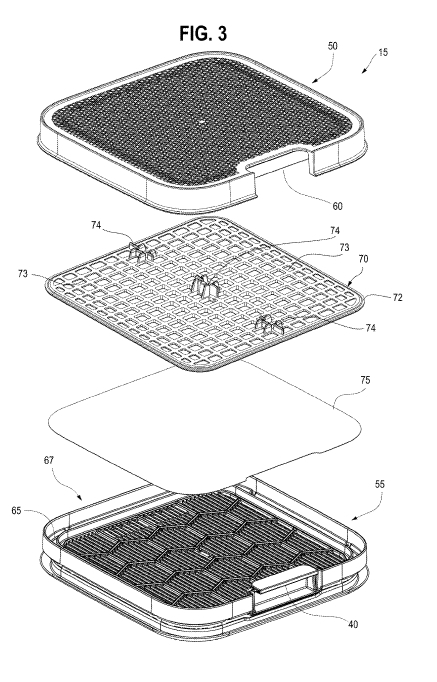
The abstract of this invention is included
below, together with the exploded Figure 3 drawing of the invention lid. The
exploded Figure 3 drawing shows top 50 and bottom 55 portions of the lid, together
with avapor-permeable membrane 75, regulating the humidity of the container, and a perforated sealing grid 70,
designed to regulatethe flow of gases
within the container. The perforated sealing grid further comprises three raised
standoff members 74, designed to facilitate the connection between the sealing
grid 70 and the top portion 50 of the lid, which is also permeable. The figure
drawing further depicts the shape and grid pattern layout of the sealing grid
apertures 73. The recessed area 60 on the front of the top portion 50 of the lid
is designed both to facilitate opening the lid, and to cooperate with the front
handle 40 of the lower portion of the lid 55.
A food storage
container is provided that may be used to increase shelf life of produce stored
therein. The food storage container is preferably used to contain produce that is
often not refrigerated, and thus subject to increased humidity levels when
stored inside a sealed container. The container preferably includes each of a
container portion and a lid member and a container portion, wherein the lid member
may be attached and removed to the container portion. The lid member may
include upper and lower lid members that are also selectively engageable with
one another. A water vapor permeable membrane layer is preferably secured
between the upper and lower lid members to help control humidity levels within
the container portion. In some embodiments, a gas permeable membrane layer may be
present between the upper and lower lid members for controlling gas flow into
and out of the container portion as well. [AbstractUS20190084756A1]
Beyond Meat® is the new faux
meat kid on the NASDAQ stock exchange, trading with the ticker symbol BYND (NASDAQ). The
company launched its IPO on May 2, 2019 with an initial share price of $25. Today, BYND shares are trading at more than $200, up 700%! The US faux meat sector of the economy is up 11%. Faux meat is hot, hot, hot! (Reinicke, 2019)
If you are wondering about cooking your own faux meat, Beyond Meat® burger patties are available in the meat
sections of supermarkets and grocery stores across the country (Bernot, 2019). Beyond Meat®
has also partnered with Dunkin’® Donuts for rolling out faux breakfast sausage sandwiches, and is preparing to roll out faux bacon (Weiner-Bronne, 2019; O'Kane, 2019). Thus, you might already find
faux sausages called Beyond
Sausages®, in two flavors: Brat Original and Hot Italian, at your local
supermarkets, and faux bacon some
time in the very near future. In the interim, you will also find Beyond Beef®
Crumbles in the frozen section of supermarkets to make tacos and/or to add to
your favorite spaghetti sauce, as well as Beyond Beef® faux ground beef (e.g.; for making meatballs). Bonus mouthwatering recipes
are included at the Beyond Meat® website.
The ingredients and processes for producing Beyond Meat® faux beef, faux sausages and faux bacon
are disclosed most recently in the US patent application US20180310599A1, titled Meat-like
food products. The Beyond Meat® 2018 patent application is uncommon in that
the 52-page document contains 80 paragraphs (7 pages in two columns) of definitions
for the special meanings of the terms used to disclose the Beyond Meat® invention.Thus, you will find useful definitions, in the description section of this patent application, for terms that may appear
obscure, such as 80/20 and 90/10 beef or crosslinking; for unusual uses of terms
such as dough, flour and gel in reference
to meat; or for dispelling the potential legal ambiguity of such terms as about, or the indefiniteness of evaluation parameters such as doneness, chewiness, cohesiveness, juiciness, gumminess, springiness, taste, texture, sizzle sound,
and mouthfeel.
The Beyond Meat® invention arises with a
threefold concern for the health, environmental and ethical issues connected to
the consumption of animal meat, animal husbandry and cruelty. Accordingly, the
invention strives to remedy with a product that is healthier than animal meat,
as nutritious, and without the high greenhouse gas footprint, and insane cruelty
associated with animal meat production.
Compared to the prior art of
plant-based meat alternatives, the Beyond Meat® invention particularly
addresses the quality of the sensory experience of eating and cooking meat
(e.g.; sounds and aromas during the transition from raw to cooked faux meat,
the mouthfeel, taste, chewiness, juiciness and texture when ingested); the
nutritional and health values of plant-based meat (e.g.; without cholesterol or high saturated fat content, or the risks of allergy to gluten and soy); and the versatility
of use (e.g.; as faux patties for burgers, faux ground meat for meatloaf and sauces, crumbles for tacos, or stuffed
in a sausage skin for hotdogs).
Indeed,
the invention seeks to exceed customer satisfaction for animal meat, in an
effort to finally win animal meat consumers over to the vegetarian and/or vegan
camp. At the end of the day, this invention is a challenge to Go Beyond™ meat, to join a movement with
different beliefs and the higher purposes of mitigating climate change and
promoting health. The company states on its website:
“Go Beyond™ isn’t a polite invitation.
It’s a bold challenge to break barriers, defy convention, shatter expectations.”
The Youtube video below spotlights the Go
Beyond™ message and movement.
The Beyond Meat® patent application recites
in great detail all the various meat-like food products: the possible
ingredients and their percentages per weight that enter into various compositions
of Beyond Meat® faux meat (e.g.; meat-like proteins, lipids, carbohydrates,
edible fibre, and moisture) and their binding agents.
The patent application also recites the
various agent release systems, including emulsions, functioning to promote such aspects of the meat-like food products as
juiciness, binding of cooked or uncooked faux
meat, taste, sizzle sounds with the release of fats, and doneness triggered by
heat from the outside to the center, interacting with the red color of the faux meat.
In particular, for some embodiments of the
invention, the red color of the faux
meat is also described as potentially using various natural extracts and their
combinations, such as for example:
“beet extract and annatto, beet extract
and turmeric, beet extract and saffron, beet extract and purple carrot, beet
extract and grape seed extract, beet extract and tomato extract, beet extract
and lycopene, beet extract and beta carotene, beet extract and anthocyanin,
beet extract and anthocyanin and annatto, beet extract and annatto and
lycopene, beet extract and ascorbic acid , anthocyanin and annatto, beet extract
and annatto and ascorbic acid, beet extract and annatto and beta carotene,
beet extract and turmeric and ascorbic acid, and anthocyanin and lycopene and
annatto.” [0142]
The abstract of the Beyond Meat® faux meat
invention is included below, together with the patent Figure 1 image of a burger. An image of the marketed uncooked Beyond Meat® patty burgers is also included above.
Provided are food products that have
structures, textures, and other properties comparable to those of animal meat, and
that may therefore serve as substitutes for animal meat. Also provided are
processes for production of such ground meat - like food products. [Abstract US20180310599A1]
-----
In the twilight zone, it remains to be
seen whether the backlash for the Beyond Meat® invention might not come from those
vegetarians who are choking at how much Beyond Meat® looks, tastes and
smells like real animal meat, when such vegetarians have not joined forces with
nutritionists who point out that highly-processed
plant-based foodsuch as faux meat is different from plant-based
whole foods (Harris, 2019; Sweeney, 2019). However, such true vegetarians are probably still far
outnumbered by vegetarians still-craving-for-meat, and meat lovers who have no
plans yet for a plant-based diet, both of which might indeed be won, in ever greater numbers, as Beyond Meat® consumers.
Business Insider Reinicke, C. (July 23 2019) - Beyond Meat® extends
its post-IPO surge to 734%, breaking the $200-a-share threshold for the first
time (BYND)
The following is a hyperlinked sample list
of additional Impossible Foods Inc., patents and patent applications, reciting
various Impossible Foods Inc.; food technology inventions. A YouTube video interview is also included, of Dr.
Patrick Brown, the Founder and CEO of Impossible Foods Inc., at Hub Culture 2018, in Davos.
Some of the patents
listed are part of large patent families. For example, the US patent
application US2017290363A1, titled Methods and compositions for affecting the
flavor and aroma profile of consumables, reciting the engineered cooking aroma
invention of Impossible Food Inc.; faux meat, belongs to a 96-member patent
family. Thus, the below list is far from exhaustive.
AU2018200707A1 - Non-dairy cheese replica comprising a coacervate
AU2016231499B2 - Methods and compositions for consumables
AU2012281064A1 - Methods and compositions for consumables
AU2014205122B2- Non-dairy cheese replica comprising a coacervate
CA2897600A1 - Methods and compositions for affecting the
flavor and aroma profile of consumables
CA2897602A1 - Methods and compositions for
consumables
CA2897606A1 - Non-dairy cheese replica comprising a coacervate
EP2943072B1 - Methods and compositions for affecting the flavor and
aroma profile of consumables
US9700067B2- Methods and compositions for affecting
the flavor and aroma profile of consumables
US9808029B2 - Methods and compositions for affecting
the flavor and aroma profile of consumables
US9833768B2 - Affinity reagents for protein purification
US9938327B2 - Expression constructs and methods of genetically
engineering methylotrophic yeast
US10039306B2 - Methods and compositions for consumables
US10087434B2 - Methods for extracting and purifying non-denatured
proteins
US2017290363A1 - Methods and compositions for affecting the
flavor and aroma profile of consumables
US2019008192A1- Methods and compositions for consumables
TR201802708T4- Tüketim ürünlerinin tat ve aroma profiline etki edilmesine yönelik yöntemler ve bileşimler [English title:Supplies methods and compositions for influencing
the flavor and aroma profiles.]
WO2013138793A2 - Affinity reagants for protein purification
WO2013010042A1 - Methods and compositions
for consumables
WO2015042405A1 - PH switchable reagents and methods for their use