Copyright © Françoise
Herrmann
Between Thanksgiving, xmas
and the New Year celebrations, including Hanukah and Kwanza, December is one
month of very intense dining, feasting and banqueting! So, here is an interesting new diet, which
boasts some very satisfied customers, with before and after pictures showing and
proving how much they have lost… relatively painlessly and effortlessly…!
The Sensa® diet is
interesting because it does not require that you change or relinquish any of what
you eat, nor does it require that you eat any special foods or drink any special
shakes, on any particular complicated schedule, and in any specific portions or
amounts.
 All that you do to follow the
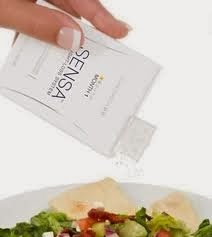
Sensa® diet is “sprinkle” Sensa® tastants on everything that you eat. The
tastants are 100% safe, containing no diuretics, no drugs and no stimulants. The
Sensa® diet sprinkler kit includes salty and sweet tastants, so you can
sprinkle the salty tastants on salty food, and the sweet tastants on your sweet
food. The only important aspect of the diet is to remember to “sprinkle” the
tastants on all that you eat….
Eventually… as every
satisfied customer testifies, you eat less and you lose weight, so that the
results become consistent with the diet small print which advocates “healthy
lifestyle, regular exercise and portion control”.
So, how does it work, and is
there a catch?...
There are three patents associated
to this diet, and a dozen more connected to the larger context! The diet arises
out of 25 years of medical research on the effects of smell and taste on
various aspects of behavior, perception and emotion, carried out by Dr. Alan
Hirsch (1997, 1998, 2003, 2004, 2006), a neurologist and psychiatrist, Director of the Smell & Taste Treatment
and Research Foundation in Chicago, Ill, and faculty member at two
institutions: The Department of Medicine at Mercy Hospital and Medical Center,
and the Department of Neurology and Psychiatry at Rush university Medical Center,
both in Chicago, Ill.
Here
is what one of Dr. Hirsch’s patents, US2009123380, titled Method
for assaying satiety-enhancing tastants, recites:
“A third to a quarter of the American population is overweight…At any
given time 40% of women and 24% of men are trying to lose weight…. In the USA,
losing weight has become a national obsession. Over 30 billion dollars are
spent each year devising a plethora of new diets….”…[0003]
Satiety
(the feeling of fullness) is the opposite of hunger. Research on odorants (using
inhalers before a meal or when hungry) corroborates the connection between
smell and weight control, and what everyone knows intuitively or by experience:
fresh baked cookies make you salivate (most of the time..), and the smell of
gas makes you nauseated. However, the research carried out on odorants also
uncovered the impracticability and conspicuousness of using an inhaler… before
every meal. So the tastant invention comes as a solution to the problems of the
otherwise successful odorant research on the regulation of weight. And, US2009123380 discloses what is marketed
and known as “Sensa®”:
“a tastant, which when applied to or admixed
with food, is effective to enhance satiety (i.e.; feeling fullness), resulting in reduced food (caloric) intake during a meal.
The satiety-enhancing composition is preferably a dry, free-flowing powder that
can be sprinkled on foodstuff to be
consumed, In one embodiment, the satiety-enhancing composting is a primarily a
sweet tastant, In another embodiment, the composition comprises a primarily salty
tastant”. [0013]
The
invention further discloses the quantified effects of the satiety-enhancing
tastants as follows:

“…the application
of the satiety-enhancing composition to foodstuffs on a daily basis will effect
a body weight loss of at least about 0.5 pound (lb) per month, preferably at
least about 1 lb per month, preferably at least 3 lbs per month, to up to about
5 lbs per month, preferably up to about 10 lbs per month, preferably up to
about 15 lbs per month, and preferably 5 lbs to about 20 lbs over an initial 6-month
period, preferably up to 25 lbs, preferably up to 35 lbs” [0016]
Wow!...
that’s lots of lost pounds!...
So what
about the Sensa® composition, what are the ingredients?
On the
sweet side, US2009123380 recites:
“Examples
of sweet tastants that can be used to achieve the benefits of the invention
include almond (benzaldehyde), anise, carob, cinnamon, cocao (natural cocao
nibs), malt , peanut (roasted), pecan, pistachio (natural), peppermint,
spearmint, and fruit-type tastants including apple, (natural apple) banana,
fig, kiwi, orange (sweet orange peel) peach, raisin, raspberry strawberry, and
the like, and mixtures or blends thereof” [0023]
On the
salty side, US2009123380 discloses:
“Examples
of salty tastants that can be utilized according ot the invention include
artichoke, asparagus, avocado, basil, broccoli, celery seed, cucumber, fennel,
garlic, horseradish, mushroom, mustard (seed), onion, Parmesan, pizza ranch,
spinach, taco, white cheese (e.g. Romano), yellow cheese (e,g.; cheddar) and
the like and admixture thereof”. [0023]
 Yum!
All of these ingredients may be derived naturally or synthetically produced…
and may include a harmless, odorless and tasteless carrier. Per the disclosure
of the invention: “Examples of such carriers include maltodextrin, dextrin, starch,
methylcellulose, sodium carboxymethylcellulose, lactose and the like, with
maltodextrin being preferred.” [0026]
The invention
also specifies the quantities of the composition ingredients: “An exemplary
satiety-enhancing composition comprises about 50% to 60% by weight tastant (dry
powder for),, about 40 % to 50 % by weight maltodextrin (granulated), 0 to 1
% by weight tricalcium phosphate, and 0
to about 3% by weight colorant, based on the total weight of the composition” [0030]
The
packaging…of the ingredients (packets, capsules… bottles, lidded cylinders…shaker-type
container…) [0031]
The
foodstuffs to which the satiety-enhancing tastants may be applied (or sprinkled)….such
as breads, pretzels, baked dishes…for the salty tastants, and puddings, cakes or cookies for the sweet
tastants. [0034]
The use of a different compositions of tastants every every month
to vary the sprinkled tastants. [0036]
And the disclosure of the invention concludes with two examples [0038-0058; 0060-0073]: The first recites
a protocol for a large-scale, open label study of the satiety-enhancing
tastants which could involve 15,000 participants. The second examples recites the
results of an actual open-label study, using the disclosed protocol of example
1, and involving 92 adults (73 females and 19 males) averaging a 197 lbs
initial body weight. The results reported are modest with a weight loss (on
average of -5.6 lbs) for a period of 6 months (or on average a weight loss of
-3%) for the test group, compared to the control group weight gain of +1.1 lbs
(or average weight gain of +0,6 lbs), but they suggest that the satiety-enhancing
tastants work, “ as a way of inducing weight loss in those attempting to lose
weight and can be integrated into a comprehensive weight loss program”. [0073]
------------
Understanding
how tastants work, on a metabolic, neurological or other level, is probably not
absolutely required … since evidently they do!
What
matters however, and what makes this a beautiful invention (aside from how
elegantly it is disclosed), is the novel approach to dieting consisting in “enhancing
satiety” compared to all the restriction and appetite-suppression-based approaches
to dieting of the Prior art.
Indeed,
Sensa® is interesting, precisely because it restricts nothing, taking nothing
away except pounds!.... Plus there is just enough time, 6 months till summer,
when you will perhaps want to wear your itsy, bitsy bikini, or your cute
Villebrequin® swim trunks!
-----------
More …
Hirsch,
A. (1997) Guide to Scentsational
Weight Loss. Element Books, Ltd.
Hirsch,
A. (1998) Scentsational sex: The secret for
using aroma for arousal. Element books Ltd.
Hirsch,
A. ( 2003) Life’s a smelling success:
Using scent to empower your memory and learning. Authors of unity Publishing.
Hirsch,
A (2004) What your doctor may not be telling you about sinusitis. Relieve your
symptoms and identify the real source of your pain. Grand Central Publishing.
Hirsch,
A (2006) What’s your food sign? How to
use food clues to find lasting love. STC
- Stewart, Tabori and Chang.