Beginning at NYU in Jan 2013 within the context of a Patents Translation course delivered online, this blog seeks to uncover the patents that rock our daily lives....
Born in 1876, Madeleine Vionnet was a French fashion designer, credited for having invented bias-cut dresses. These were dresses cut at a 45-degree angle to the fabric’s warp and weft threads, instead of straight along the grain. As a result, Vionnet was able to drape dresses, using the natural stretch of the fabric, which enabled her to create dresses that mold women’s bodies. Indeed, Vionnet was part of a movement in the 1930s that liberated women from the corset, creating figure-hugging garments that flowed, instead of restricting women’s bodies.
Madeleine Vionnet opened her own Fashion House, rue de Rivoli, in Paris, in 1912, which she was forced to close twice: once because of World War I (in 1914), and a second time because of World War II (in 1939). Thus, she was a leading fashion designer during the roaring 20s up to the Great Depression, between both wars. The archives of her work are preserved at the Decorative Arts Museum (Musée des Arts Décoratifs [MAD]), housed in the Marsan Pavillion at The Louvre, in Paris.
The following French utility patent, FR576334A, titled Perfectionnement dans la confection des robes de dames [Improvements in dressmaking for ladies] was granted on May 10th, 1924. The patent recites an improved process for dressmaking whereby the garment’s pattern, and the fabric’s ornaments or decorations, in this case lamé, are both anticipated and drawn, prior to weaving the fabric.
This improved dressmaking process was intended to resolve several problems with the prior art. First, this improved dressmaking process eliminated the costly and time-consuming process of embroidering lamé, or adding decorations onto the fabric, after it is cut and assembled for each client. Secondly, this improved dressmaking process avoided “mutilating” lamé designs and fabric decorations, pre-woven on a bolt of material, which was then subsequently cut to the neckline, armholes, waist or hip line of a given pattern. In other words, the dressmaking improvement avoided interrupting an existing motif, or wasting fabric to get a pre-existing motif to fit the garment shape and pattern. Finally, the invention would enable garments to be easily adjusted to size and length, without cutting into a pre-existing design. The fabric decoration, lamé, or other embroidery or painting, would be created within the boundaries (collar, arm holes, waistline) of an outlined pattern, prior to weaving, thus transforming the dressmaking end-of-process—garment cutting and assembly— into swift and cost-effective steps.
The patent Figure 2 is included below, together with an image of a marketed dress. The Figure 2 depicts a cut and assembled dress with the ornamental decoration at the top, perfectly fitting the neckline and shoulder assembly points, without interruptions to the ornamental motif.
MAD - Madeleine Vionnet Puriste de la Mode. Catalogue de l’Exposition du 24 juin 2009, au 1er janvier 2010. Musée des Arts Décoratifs, Pavillon Marsan du Musée du Louvre.
The documentary, Textile Mountain, produced by Make Europe sustainable for all** shows the impact of the 4 million-ton surplus of used clothing in the world. 70% of which is sold in bales to sub-Saharan Africa. 50% of which is in such a bad state, it ends up in dumps on riverside beds, the sides of roads, or in large fields, such as the well-known, 30-acre, ‘Dandora Dumpsite’ (mountain), on the outskirts of Nairobi (in Kenya).
The remaining ‘re-usable’ mitumba that floods African markets also ends up canceling all local textile production, since no one can compete with the price or quantity of mitumba. In response to this situation, the documentary highlights two exemplary European solutions to textile waste.
ISATIÓ, a company that uses the principles of a circular economy to upcycle fabric samples into high-quality fashion products, in Brussels, Belgium.
Nuw Wardrobe, a fashion exchange app and social networking community for sharing clothes, in Dublin, Ireland.
As Annie Leonard, founder and author of The Story of Stuff projectputs it: There is no such thing as ‘away’. When you throw something away, it must go somewhere.
-----------
Note
* mitumba is the Swahili term for 'used clothing imported from abroad'.
** Make Europe sustainable for all (MESA), a three-year Development, Education and Awareness-raising (DEAR) project, combining the expertise and experience of 25 partners from 14 EU countries, EU and global
networks. MESA was designed to increase awareness of roles and responsibilities of EU citizens and policymakers in creating a sustainable future for all. The project began in July 2017, and ended in July 2020.
Leonard, A. (2011). The Story of Suff: The Impact of Overconsumption on the Planet, Our Communities, and Our Health-And How We Can Make It Better. New York, NY: Free Press. Nuw (Instagram) https://www.instagram.com/wearenuw/
Textile Mountain (website) https://www.textilemountainfilm.com/ Textile Mountain (YouTube video in English) [21:39] - European Environmental Bureau (May 29, 2020).
https://youtu.be/UC4oFmX8tHw Textile Mountain (Youtube video available with subtitles in the following languages)
A hospital gown designed by a well-known fashion stylist? Yes, a hospital gown designed by Diane von Fürstenberg, celebrated for her iconic wrap-around dresses, chairwoman of the Council of Fashion Designers of America (CFDA) from 2006 to 2019, and inducted into the National Women’s Hall of Fame in 2019, among many additional accolades.
The US utility patent, US8990966, titled Medical garment, was awarded to Diane von Fürstenberg, Erin Przekop, and Jeanne M. Ryan, on March 31st, 2015, and assigned jointly to Diane von Fürstenberg Studio L.P., and The Cleveland Clinic Foundation. Although the patent is a utility patent vs. a design patent that would otherwise cover only the ornamental aspects of the gown, the patent explicitly addresses both functionality and appearance. The functionality of being able to easily access a patient’s body for examination. The attractiveness of a gown that might be comforting to patients, while still providing coverage. Most importantly, an inventive gown that might also be fastened by patients without assistance, since the patent states that most hospital gowns are inspired by 19th-century night shirts, further tailored in a variety of ways to open and close in the back.
Commissioned by the Cleveland Clinic to design a gown, Diane von Fürstenberg (2021) stated: “ I was taken aback. I thought, “Why?” But then I understood: It’s about the dignity of the patient.” Fürstenberg then explained that she designed a print and worked with the hospital nurses on the gown’s functionality. In particular, she mentions that the gowns come in three sizes that are color-coded so that the correct size might be easily grabbed in a hurry.
The patent Figure 1, shown above, depicts a plan view of the inventive garment or gown 11, comprising three substantially rectangular panels, one central panel 12, and two side panels 13 and 14. The central panel 12 has a right edge 12c, and a left edge 12 b, respectively joined via the right seam 17, and the left seam 16, to the side panels 13 and 14.
The gown comprises two sleeves, a right sleeve 21, and a left sleeve 18, attached to the central and side panels (11-14) through the right and left armholes 22 and 19. The two sleeves 18 and 21 further comprise corresponding slits 36 and 37, secured with fasteners 38, to enable access to the patient’s arms.
The gown also comprises a V-neck 39, which may be worn on the front or on the back of a patient's body. When the gown is worn with the V-Neck 39 on the front, the pocket 41 appears on the patient’s chest. When the V-neck 39 is worn on the back, the pocket 48 appears on the patient's chest. The gown comprises two more pockets, the side pocket 32 attached to the seam 16, and the side pocket 33 attached to the seam 17.
The gown further comprises a tunnel-like waistband 23, extending across the left panel 13 and the central panel 12. A first belt 24 is anchored at point 24a on the seam 16, and extends out of the waistband 23, through the side panel 13. A second belt 26 is anchored at point 26a, also on the seam 16, but it extends out of the waistband 23, through the central panel 12. Both belts 24 and 26 cooperate like drawstrings to cinch the waistband 23. Two additional ties 28 and 27 are provided, respectively attached to the outer edge of the side panel 14, and to the seam 16, both at waistband 23 height. The ties, 28 and 27, are meant to coordinate with the cinching drawstring belts, 24 and 26.
Although the gown is described as a medical gown for use at hospitals, nursing homes, doctors’ offices, and other healthcare facilities, the scope of the invention is recited as extending to health spas, beauty salons, as well as to private uses, or to uses requiring the functionalities of the garment. In terms of materials, the patent recites multiple suitable materials, such as natural or synthetic fabric. Synthetic fabric unlimited to polyester, acrylic, polyamide or polyolefin fiber and combinations, provided that both the materials and the tailoring can sustain the rigors of use and multiple washing.
The patent abstract is included below.
A medical garment formed of a central body region and two side regions with a pair of belts and a pair of fasteners for securing the garment around a patient’s body is provided. The central body region may be worn on the back or front and may have a V-neck form. A waistband extends across the central body region and across one side region with a first belt secured at the junction of the central region and the second side region and extending to the outer edge of the first side region. The second belt extends from the secured end of the first belt through the waistband across the central body region, the second belt exiting the waistband at the junction of the second side region and central body region. A first fixed tie is positioned at the outer edge of the second side region along the position of the waistband. A second fixed tie is secured to the inside of the waistband between the central body region and first side region. This garment design allows for easy gathering of fabric to present a secure and attractive body covering. [Abstract US8990966]
The Tunisian-born couturier, Azzedine Alaïa, established his fashion house in Paris, France, in 1964. Since then, several iconic Azzedine Alaïa pieces have been granted US design patents. For example, theit-pièce (in English, hit piece) Le Papa bag, is a patented design. The US design patent USD979236S1, titled Shoulder bag, was granted on Feb. 8, 2023, to Angela Lauria, and assigned to Azzedine Alaïa SAS, in Paris, France.
Le Papa bag honors the deceased founder, Azzedine Alaïa, and his eponymous fashion house, known to function more like a family. A family that is continuing his legacy. According to fashion lore, Azzedine Alaïa developed close working relationships with his models, including Grace Jones, whose costumes he designed, in 1985, for the 14th James Bond movie, A View to Kill.
Below, the patent Figure image 1.1, together with black and white marketed models of the treasured Le Papa piece. A piece produced in three different sizes and several different materials. A design that turns the "A", representing the house's name, Alaïa, upside down.
As a reminder, a US design patent covers the ornamental aspects of an inventive design, or how the design looks. In contrast, a US utility patent covers the functional aspects of an invention, or the way the invention works. Thus, this patent excludes all but the stunning looks of Alaïa's Papa bag.
References
A View to Kill (1985). James Bond movie, starring Roger Moore and James Bond and Grace Jones as May Day and music by Duran Duran. (Original Trailer)
The famous French tennis player, Jean-René Lacoste (1904-1996), seven-times Grand Slam winner, first became known as “The Crocodile” in the American Press of the 1920s, due to the combination of tenacity and fierceness of his game. He was the best male tennis player of the late 1920s, on both sides of the Atlantic, once he beat Bill Tilden, the reigning American champion.
What is less known about Jean-René Lacoste is that he was also an inventor, who was granted more than 30 patents for inventions that truly changed the world of tennis and sports fashion. Indeed, before following his passion for playing tennis, and becoming a successful tennis player, Lacoste was a polytechnicien, an engineer with a dynamic drafting board, who got into Polytechnique, France’s most competitive and prestigious engineering school. Thus, all of Lacoste’s inventions were seriously technical.Whether related to new light metal tennis rackets, ball-throwing practice machines, or the combination of technical comfort and elegance in sports fashionwear (on and off the courts), Lacoste’s inventions were both transformative and enduring.
Even the well-known Lacoste Crocodile logo, now found on all Lacoste fashionwear, was a significant game-changer, as it was one of the first visible logos found on clothing of the 1920s. A humorous appropriation of the nickname the press had given him, stitched directly onto the front left side of his jackets, making Jean-René Lacoste immediately recognizable, while also ushering in a brilliant marketing trend.
The Lacoste crocodile trademark is active as ever, posting 10-figure revenues for the Lacoste company that was originally founded in 1933. The below Lacoste crocodile trademark was registered on Aug. 15th 2006, at the USPTO Trademark Database, with the serial No. 78713877. The trademark is owned by Lacoste Alligator S.A. Corporation Switzerland. The claimed Lacoste crocodile mark is described as follows:
“The color(s) green, white and red is/are claimed as a feature of the mark. The mark consists of a stylized representation of an alligator or crocodile. The mark is green, with a red mouth and white dots and white eyes."
Launched Fall 2010, and now discontinued, Levi’s®Curve ID jeans nonetheless trail blazed the design of women's jeans, according to body shape, instead of size. The campaign for “shape not size” jeans, together with the production of Levi’s® Curve ID jeans, arose out of a combination of one-on-one interview research with women worldwide, and the study of more than 60,000 3D body scans.
First, the results of the interview research uncovered the fact 54% of women try on at least ten pairs of jeans to find a pair that reasonably fits their body shape. Then, the results of the body-scan study initially identified three body shapes that represent 80% of women worldwide. The three initial body shapes identified were Slight Curve, Demi Curve and Bold Curve.(1)
From then on, in-store Curve ID measurement specialists were available to assist women in their purchase of perfectly fitting jeans that matched their particular body shape. The measuring tool used to determine which of the Curve ID fits matched a particular customer’s body shape, is a patented invention. The US utility patent reciting this invention, US8763262B2, titled Shape measuring tool, was awarded on July 1st 2014.
The patent discloses a measuring tool designed to resolve the prior art issues of patent fit, informed by sizes measured in numbers, or waist and inseam length. Using prior art sizes, two people with the same size did not necessarily find jeans that fit in the same way. The fit was different, because two people with same jean size may have different proportions (i.e., their waistband, hips and seat measurements may be different, relative to different height.) Thus, for one person a pair of jeans might fit at the waist, but not in the seat. Conversely, for another same-size person, the jeans might fit in the seat, but not in the waist, even creating what the patent recites as a “muffin top” silhouette.
Below, the abstract of the invention is included, together with the patent Figures 2 and 7. The patent figures respectively depict a front view of the shape-measuring tool 201 with two measuring tapes 208 and 212 attached to a belt 204 (Fig. 2), and a front view of the shape-measuring tool, tied around a person’s waist with a string belt 704, measuring at least 30 inches to accommodate various waist sizes, and secured with a bow 708 (Fig. 7). In particular, the measuring tapes 208, 212 (Fig. 2), are respectively attached to the string 204 via wraparound fastener or suspension loops 216, 220, each respectively attached to the tapes with a rivet 222, 223. The fastener loops 216, 220, each slide on the belt 204, enabling the measuring tapes 216, 220 to be positioned anywhere on the belt. The length of the measuring tapes 216, 220 is sufficiently long to enable girth measuring of a person’s shape at the waist, hip and seat. The measuring tapes are at least 12 inches long, but their length is also specified above the ground, in view of preventing potential tangling, and/or tripping.
Two girth measurements are taken, parallel to a person’s waist, using the ruled markings on the measuring tapes as guides. The ruled markings include both the customary American units (inches), and the International system of units (cm). The distances between girth measurements relative to a person’s waist enable measurement of a ratio between hip and seat, which together will determine the shape fit category of the jeans for a particular person. Thus, reading of the two girth measurements against markings of the two shape measuring tapes, introduced a new and revolutionary measurement of jean shape fit, according to the Slight, Demi or Bold shape categories, in addition to the existing categories of jean style, and size, for a particular person.
The scope of the invention extends to variations of such items as: dimensions and materials of the belt, means for attaching the belt to a person’s waist (e.g., buckle or bow) and, design of the two shape-measuring tapes with ruled markings, which might include panels, and clips to further point to relevant jean fit reference points.
A measuring tool is used to measure the shape of a person’s body. The tool has a belt and at least one measuring tape attached, which extends perpendicularly to the belt. The tool is held to the person's waist with the belt. While the person is standing, shape measurements are typically made at one or more points based on the measuring tape. This measuring tape extends a length sufficient to include the person’s seat and hip, where the shape will be measured, but will generally not be as long as the person’s leg or long enough to touch the ground.[Abstract US8763262B2]
---------
Note (1). Encompassing still more body shapes, a fourth Curve ID size, called Supreme Curve was launched Spring 2011, together with added rises and extended sizes. (Levi Strauss Press Release).
Early October 2021, Stella McCartney
took the runways of the Paris Fashion Week by storm with a Spring 2022 collection,
celebrating sustainable mycelium fashion (Friedman, Oct. 5, 2021), aka patented recombinant mushroom technologies.
Scroll forward to COP26 in Glasgow UK, and the hottest cruelty-free House of
British fashion was also present, exhibiting: The Future of Fashion. A showcase of fashion
innovation powered with such sustainable
patented technologies as Mylo™ leather and Microsilk™ (Mitchie, 2021). An exhibit that brought together the fashion industry, responsible for an estimated 18% of GHG, into sharp
focus.
Indeed, lab-grown mycellium and silk thread
technologies have a much smaller carbon footprint. A smaller footprint compared to the millions of animals in cattle ranching, whose hides are used to manufacture shoes, accessories and apparel; or compared to the use of
silkworms, and the impossible use of spiders.
More deeply, however, lab-grown Mylo™
leather and Microsilk™ are 100% cruelty-free,
the hallmark of Stella McCartney fashion (Stella McCartney). A truly synergistic hallmark that brings together climate change,
sustainability, ethical treatment of animals, and the best of the fashion world,
all under a single banner.
The fashion industry’s commitment “to
net-zero greenhouse gas (GHG) emissions by 2050 in line with keeping global warming below 1.5
degrees Celsius”, consistent with the provisions of the UNFCCC(1) 2015 Paris Agreement, was initially set forth in the UNFCCC 2018 Fashion Industry Charter for Climate Action, launched during COP24 in Katowice,
Poland. However, as Stella McCartney pointed out in an
interview on Nov 4th 2021 with CNN, the fashion industry is “the
most unfashionable” in terms of sustainability, as it still lags far behind
with no regulations in sight for monitoring emissions, setting deadlines,
implementing accountability, or for supplying incentives for change.
A viewpoint that appears largely shared by other fashion
industry leaders, since according to Vogue, the COP26 Fashion Charter event resulted not
only in additional signatories to the existing group of 130 brands(2), but also
a renewed commitment to more concrete, more ambitious, and much stronger action
in view of achieving the goals set forth in the 2015 Paris Agreement on climate
action (Chan, 2021). Tighter control, such as phasing out coal from tiers one and two
suppliers by 2030, and no new coal by 2050, or requiring brands to submit plans
for climate action. A COP26 takeaway in
the form of an amended UNFCCC Fashion Charter for Climate Action, considering that, according to The Global Fashion Agenda the Fashion industry’s emissions, at their
current pace, are set to rise to 2.7
billion tons by 2030, which is double
the amount required to keep climate warming below the 1.5 degrees (Fashion on Climate Report, 2020).
The patented
technologies driving Stella McCartney's Future of Fashion include Mylo™ leather, and Microsilk™, both produced by the California Bay Area company
Bolt Threads. Leather that meets the Stella McCartney criteria of “ cruelty-free
alternatives that look and feel luxurious and have [in this case] an environmental impact that is up to 24 times
lower than animal leathers.[ilalics mine]" (Stella McCartney). Likewise, Microsilk™ is a vegan product, made entirely from yeast, sugar and DNA, with high tensile strength, softness, elasticity
and durabulity, fabricated using green chemistry practices to minimize the environmental
footprint.
Indeed, according to Stella McCartney, there are no sacrifices in The Future of Fashion. Quite the contrary, when technology, ethics and sustainability are
synched, The Future of Fashion is invigorated, and more stunning than ever, as evidenced in the included clip of the Stella McCartney Spring 2022 show (Cohn, 2021).
Imagine now what might happen, considering that the fashion Houses of Louis Vuitton, Dior, Givenchy, Celine, Loewe, Fendi, Marc Jacobs, and the like of luxury and prestige, belonging to the LVMH group, are all on board (i.e.; signatories) for climate action!
Notes
(1) UNFCCC - United Nations Framework on Climate Change Convention. (UN on Climate Change)
(2) The LVMH (Moët Hennessy Louis Vuitton)conglomerate which groups 75 luxury Houses such as Dior, Yves Saint Laurent, Givenchy,
Kenzo and Fendi signed on to the Charter.
Whoever says you
cannot wear shapewear with high slit skirts and dresses has missed the SKIMS™ Shapewear Solution Shorts #1 and #2, respectively for left or right leg
exposure. Designed by Kim Kardashian West et al., SKIMS™ Shapewear Solution Shorts precisely
resolve the issue of women’s right or left leg exposure, when wearing high-slit
skirts and dresses, while continuing to offer all the advantages of body sculpting
shapewear, in terms of smooth lines, rear shaping, and lift. SKIMS™ Shapewear
Solution Shorts simply offer more coverage on one leg than on the other. A
solution that is patented in both the United States, and elsewhere, via the
United Nations World Intellectual Property Organization (WIPO)(1).
The SKIMS™ Shapewear Solution Shorts invention is disclosed in the US utility patent US10806190B, titled Shapewear undergarment. The patent was awarded on October 20th 2020, to Kim Kardashian West and Jens Grede, and assigned to SKIMS Body Inc. The patent discloses an
asymmetrical pair of shorts with a greater distance of the thigh covered, on one
side, relative to the other.
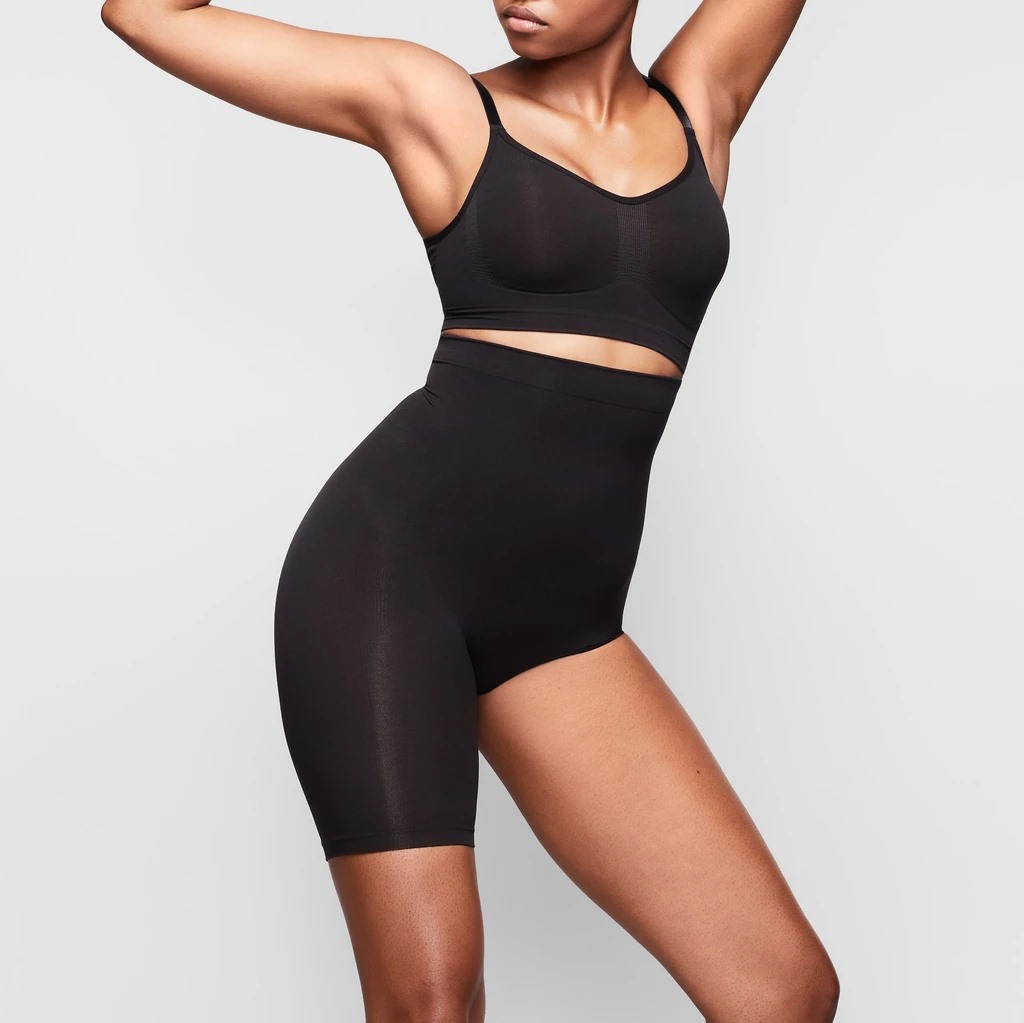
Below, the abstract of the patent together with the patent Figures 2 and 9, respectively depicting front views of the patented solution shorts with left and right leg exposure. Images of a model wearing the SKIMS™ Shapewear Solution Shorts, respectively with right and left leg exposure, are also included.
A shapewear undergarment can include first and second leg openings where the first leg opening is located at a greater distance from a hip portion than the second leg opening, such that the shapewear undergarment will cover a greater portion of a wearer's first thigh than the wearer's second thigh when worn. [AbstractUS10806190B1]
Specifically, the
front view Figures 2 and 9 depict the shapewear undergarment worn by an imaginary
person. The undergarment has a hip portion 12, a midsection portion 14, and two asymmetrical leg portions 22 and 24.
The midsection portion 14 suggests a potential extension of the shorts, shaping the midriff. Figure 2 depicts a leg portion 22 longer than the leg portion
24. Conversely, Figure 9 depicts a leg portion 24 longer than the leg portion
22.Thus, on Figure 2, a greater portion
of the wearer’s left thighis exposed,
whereas on Figure 9, a greater portion of the wearer’s right thigh is exposed.
Figures
2 and 9 also
respectively depict different leg openings 23 and 25.Figure 2
depicts a horizontal leg opening 23 on the longer side, whereas Figure 9
depicts an upswept leg opening 23 on the short side. Conversely, Figure 2
depicts an upswept opening 25 on the shorter side, whereas Figure 9depicts a
horizontal leg opening 25 on the longer side. The upswept openings 23 and 25,
respectively depicted on Figures 9 and 2, extending from the inner thigh to the hip, are both designed to accommodate more exposure of the hip, in case the slit garment, under
which the Shapewear Solution Shorts are worn, has a slit that extends as far as the hip.
Interestingly, the
Shapewear Solution Shorts are also disclosed as alternatively reversible. In other words, instead of
one pair of shorts for right-side exposure, and another pair of shorts for left-side exposure, the shorts might simply be turned around, so that the longer
portion 22 for one leg becomes the longer portion 22 for the other leg. The
Shapewear Solution Shorts are further disclosed as performing smoothing, enhancing,
shaping, compression, or other sculpting functions, using material known to the
state of the art. Particularly, the Shapewear Solution
Shorts are also disclosed as offering light, medium or high compression, with
varying areas of compression, also variously graduated.
-------------
Note:
(1) The WIPO patent family member WO2020251619A1, titled Shapewear garment, also recites the Shapewear Solution Shorts invention.
The latest Internet-connected and haptic
technology-enabled piece of fashionwear from CuteCircuit is the Music Shirt™. Nominated one of Time Magazine’s 100 Best Inventions of the Year, on November 19, 2020, the CuteCircuit Music Shirt™ enables wearers to immerse themselves into music, and deaf wearers in
particular, to feel the sounds of music.
Using the principles of actuator technology, also invoked to mastermind the Hug Shirt™, the Music Shirt™ is equipped
with sixteen actuator motors that generate varying vibrations and pulses, according to sounds. Thus, the Music Shirt™ algorithm is
able to translate music sounds, captured and recorded digitally, into
strategically placed vibrations on a Bluetooth®-connected Music Shirt™, enabling wearers, deaf in
particular, to experience music viscerally. For example, an orchestra floor is
mapped into different recording sections, the converted sounds of which will be distributed variously on a Bluetooth®-connected Music Shirt™. As a result, sensations of the lowest drum sounds
are translated into vibrations felt in the abdomen area, while all the higher
frequency sounds of flutes and violins are felt as vibrations on the upper
body, including the intensities and variations of rhythm and beat.
The Music Shirt™ is available for individual purchase,
and at various music venues, offering an immersive music experience. For example, the following YouTube video shows several deaf wearers' haptic experiences, in
collaboration with the Junge Symphoniker Hamburg, in Germany.
The CuteCircuit Music Shirt™ was created by Francesca
Rosella (Italy) and Ryan Genz (USA), founders of the pioneering, wearable
technology, fashion brand company CuteCircuit. The Music Shirt™ functions using
the Hug Shirt™ app, where users might select music pieces to playback on a Bluetooth®-connected Music Shirt™. The Music Shirt™ also functions using the QPro music software,
enabling musicians to create music that includes the haptic sensory experience
of the Music Shirt™.
The patent-pending Music Shirt™ invention
arises at the intersection of several patented domains such as 3D Spatial
Audio, Haptics for Augmented Reality, Interactive Luminous Garments,
Multimedia Wearable Telecommunication Devices, and Sensor Enhanced Fabric
constructions.