Monday, January 6, 2014

Oh, patents! Google strips....


Copyright © Françoise Herrmann

Trust Google, Inc., to change the world and to bring in new modes of communication!  Here’s another one of these brilliant ideas

Patent US 8621366, titled Self-creation of comic strips in social networks and other communications, awarded just a few days ago, on December 31, 2013 to Satish Kumar Sampath in the UK, and assigned to Google, Inc. in Mountain view, brings you the capacity to communicate in comic strips on social networks, without having to resort to another program or third party site. 
  
Embedded pictures and videos were a great improvement on plain text…  But, now you can try out your expression in comic strips! The patent discloses how to embed a comic strip generator into a social media platform so that you can easily say it all much more succinctly in bubbles, and disguised as your favorite alter ego.

The Abstract and cover page drawing for US8621366 sum it all up really nicely:


Abstract US8621366
"Commununications to be shared on social networks and other electronic modes of communication are presented in comic strip form. The comic strips are created with a simplified user interface and are formatted to be well-suited for display on a selected social network or other electronic facility. The comic strips are displayed in an embedded form directly in the social network or other facility, without the need for a user to go to a separate site to view the comic strip".

So, once this application has gone viral on the social networks, just proceed per the Figure 4 algorithm:  “Select a theme for comic strip; Enter a title for comic strip; Enter text for comic strip; Preview the comic strip; Share the comic strip” as illustrated in Figure 5 of the patent below, and you probably can stay home for the day!


Personally, I cannot wait for launch day!

 I also hope this application will be seamlessly embedded in Blogger and Chrome! It will beat jpeg-ing  bubbles  for wraparound text. 


Sunday, January 5, 2014

Oh, patents! Tegu® blocks

Copyright © Françoise Herrmann

Have you ever played with Tegu® blocks? They are small, exquisitely crafted wooden blocks, engineered with magnets, enabling you to create structures that are otherwise impossible to build with gravity sensitive blocks or even with more engineered plastic blocks such as Legos®. 

The blocks are called Tegu® in honor of Tegucigalpa, the name of the capital city of Honduras where they are manufactured. They are made from sustainably harvested mature wood and a portion of the proceeds from the sale of the blocks is returned to the local communities for re-planting trees. With just the purchase of a small pouch of magnetic Tegu® blocks, you will have replanted 1 tree.


The toy company, co-founded in 2006 by Chris and Will Haughey, was also committed to creating a for-profit business that had a real positive and transformative effect on the lives of the people in the Honduras community where the blocks are manufactured. So Tegu® blocks also bring jobs and a stable future to the workers involved in the manufacture, and education to the children in neighboring schools..

The most striking feature of these blocs, beyond the impeccable social entrepreneurship, the “clic-clac” sound of two blocks coming together, and the endless creative and gravity-defying possibilities for play and building that they afford, is their texture, and the completely, seamlessly invisible, encasing of the magnets. Tegu® magnetic blocks look and feel like magnetic wood.


It is this special engineering of the blocks with magnets that is patented in WO2010111189, titled Magnetic blocs and method of making magnetic blocks.

The manufacturing algorithm discloses insertion of the magnets inside the machined pockets of two non-extrudable, grain-matched, block parts, with prior or subsequent cutting or shaping of the exterior Tegu® block.

Below, you will find the abstract of the invention, to the right an exploded patent drawing of the magnet and block part assembly, and in color some of the marketed shapes and creative play constructions.

Abstract  WO2010111189
A method of making blocks with internally disposed magnets (108). Pockets (106) for the magnets are machined into a non-extrudable material such as wood. Strong permanent magnets are disposed in the pockets to cause the faces of the block to exhibit a desired polarity magnetic field. The pockets are then sealed to permanently retain the magnets. The exterior shape of the block may be formed either prior to or subsequent to machining and sealing of the pockets.

Saturday, January 4, 2014

Older sibling blogs for Patents on the soles of your shoes


Copyright © Françoise Herrmann


The following are two big brother blogs for Patents on the soles of your shoes brought to you both by librarians, experts at patent searching, and at finding the most wonderful, whimsical or strange patents ever filed.

------

The Patent Search Blog – Steven van Dulken ‘s blog on patents and IP
This blog is written by an information search expert who worked for the British Library for more than 35 years. Mr. van Dulken retired in April 2013, but is still active as a private information search specialist and continues to blog at Blogger: The Patent Search Blog http://stephenvandulken.blogspot.co.uk
The latest Jan 3, 2014 post is about the Mills bomb patent, the first modern fragmentation grenade..... which is one way to start the new year with a huge bang! J

The Patent Librarian’s Notebook by Steven white
This blog is written by a librarian for research services at the Engineering and Science Library at Queen’s University in Kingston, Ontario, since 1991 and previously for the USPTO. 
The latest Dec. 31, 2013 post compiles some useful 2013 USPTO statistics, which will give you a glimpse of activity at the USPTO, and save you the time spent on examining all the USPTO statistical dashboards. This is a “year in review” tradition on this blog, where you will also find posts about the “humble egg carton” patents, and toy puzzle patents for children.


Friday, January 3, 2014

Oh, patents! SENSA® weight loss system

Copyright © Françoise Herrmann

Between Thanksgiving, xmas and the New Year celebrations, including Hanukah and Kwanza, December is one month of very intense dining, feasting and banqueting!  So, here is an interesting new diet, which boasts some very satisfied customers, with before and after pictures showing and proving how much they have lost… relatively painlessly and effortlessly…!

The Sensa® diet is interesting because it does not require that you change or relinquish any of what you eat, nor does it require that you eat any special foods or drink any special shakes, on any particular complicated schedule, and in any specific portions or amounts.

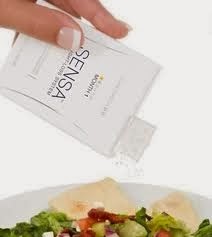
All that you do to follow the Sensa® diet is “sprinkle” Sensa® tastants on everything that you eat. The tastants are 100% safe, containing no diuretics, no drugs and no stimulants. The Sensa® diet sprinkler kit includes salty and sweet tastants, so you can sprinkle the salty tastants on salty food, and the sweet tastants on your sweet food. The only important aspect of the diet is to remember to “sprinkle” the tastants on all that you eat….

Eventually… as every satisfied customer testifies, you eat less and you lose weight, so that the results become consistent with the diet small print which advocates “healthy lifestyle, regular exercise and portion control”.

So, how does it work, and is there a catch?...

There are three patents associated to this diet, and a dozen more connected to the larger context! The diet arises out of 25 years of medical research on the effects of smell and taste on various aspects of behavior, perception and emotion, carried out by Dr. Alan Hirsch (1997, 1998, 2003, 2004, 2006), a neurologist and psychiatrist, Director of the Smell & Taste Treatment and Research Foundation in Chicago, Ill, and faculty member at two institutions: The Department of Medicine at Mercy Hospital and Medical Center, and the Department of Neurology and Psychiatry at Rush university Medical Center, both in Chicago, Ill.  

Here is what one of Dr. Hirsch’s patents, US2009123380, titled Method for assaying satiety-enhancing tastants, recites:
 “A third to a quarter of the American population is overweight…At any given time 40% of women and 24% of men are trying to lose weight…. In the USA, losing weight has become a national obsession. Over 30 billion dollars are spent each year devising a plethora of new diets….”…[0003]

Satiety (the feeling of fullness) is the opposite of hunger. Research on odorants (using inhalers before a meal or when hungry) corroborates the connection between smell and weight control, and what everyone knows intuitively or by experience: fresh baked cookies make you salivate (most of the time..), and the smell of gas makes you nauseated. However, the research carried out on odorants also uncovered the impracticability and conspicuousness of using an inhaler… before every meal. So the tastant invention comes as a solution to the problems of the otherwise successful odorant research on the regulation of weight. And, US2009123380 discloses what is marketed and known as “Sensa®”:
 “a tastant, which when applied to or admixed with food, is effective to enhance satiety (i.e.; feeling fullness), resulting  in reduced food (caloric) intake during a meal. The satiety-enhancing composition is preferably a dry, free-flowing powder that can be sprinkled on foodstuff  to be consumed, In one embodiment, the satiety-enhancing composting is a primarily a sweet tastant, In another embodiment, the composition comprises a primarily salty tastant”. [0013]
The invention further discloses the quantified effects of the satiety-enhancing tastants as follows:

“…the application of the satiety-enhancing composition to foodstuffs on a daily basis will effect a body weight loss of at least about 0.5 pound (lb) per month, preferably at least about 1 lb per month, preferably at least 3 lbs per month, to up to about 5 lbs per month, preferably up to about 10 lbs per month, preferably up to about 15 lbs per month, and preferably 5 lbs to about 20 lbs over an initial 6-month period, preferably up to 25 lbs, preferably up to 35 lbs” [0016]
Wow!... that’s lots of lost pounds!...

So what about the Sensa® composition, what are the ingredients?

On the sweet side, US2009123380 recites:
“Examples of sweet tastants that can be used to achieve the benefits of the invention include almond (benzaldehyde), anise, carob, cinnamon, cocao (natural cocao nibs), malt , peanut (roasted), pecan, pistachio (natural), peppermint, spearmint, and fruit-type tastants including apple, (natural apple) banana, fig, kiwi, orange (sweet orange peel) peach, raisin, raspberry strawberry, and the like, and mixtures or blends thereof” [0023]
On the salty side, US2009123380 discloses:
“Examples of salty tastants that can be utilized according ot the invention include artichoke, asparagus, avocado, basil, broccoli, celery seed, cucumber, fennel, garlic, horseradish, mushroom, mustard (seed), onion, Parmesan, pizza ranch, spinach, taco, white cheese (e.g. Romano), yellow cheese (e,g.; cheddar) and the like and admixture thereof”. [0023]
Yum! All of these ingredients may be derived naturally or synthetically produced… and may include a harmless, odorless and tasteless carrier. Per the disclosure of the invention: “Examples of such carriers include maltodextrin, dextrin, starch, methylcellulose, sodium carboxymethylcellulose, lactose and the like, with maltodextrin being preferred.” [0026]

The invention also specifies the quantities of the composition ingredients: “An exemplary satiety-enhancing composition comprises about 50% to 60% by weight tastant (dry powder for),, about 40 % to 50 % by weight maltodextrin (granulated), 0 to 1 %  by weight tricalcium phosphate, and 0 to about 3% by weight colorant, based on the total weight of the composition” [0030]

The packaging…of the ingredients (packets, capsules… bottles, lidded cylinders…shaker-type container…) [0031]

The foodstuffs to which the satiety-enhancing tastants may be applied (or sprinkled)….such as breads, pretzels, baked dishes…for the salty tastants,  and puddings, cakes or cookies for the sweet tastants. [0034]

The use of a different compositions of tastants every every month to vary the sprinkled tastants. [0036]


And the disclosure of the invention concludes with two examples [0038-0058; 0060-0073]: The first recites a protocol for a large-scale, open label study of the satiety-enhancing tastants which could involve 15,000 participants. The second examples recites the results of an actual open-label study, using the disclosed protocol of example 1, and involving 92 adults (73 females and 19 males) averaging a 197 lbs initial body weight. The results reported are modest with a weight loss (on average of -5.6 lbs) for a period of 6 months (or on average a weight loss of -3%) for the test group, compared to the control group weight gain of +1.1 lbs (or average weight gain of +0,6 lbs), but they suggest that the satiety-enhancing tastants work, “ as a way of inducing weight loss in those attempting to lose weight and can be integrated into a comprehensive weight loss program”. [0073]
------------

Understanding how tastants work, on a metabolic, neurological or other level, is probably not absolutely required … since evidently they do!

What matters however, and what makes this a beautiful invention (aside from how elegantly it is disclosed), is the novel approach to dieting consisting in “enhancing satiety” compared to all the restriction and appetite-suppression-based approaches to dieting of the Prior art.

Indeed, Sensa® is interesting, precisely because it restricts nothing, taking nothing away except pounds!.... Plus there is just enough time, 6 months till summer, when you will perhaps want to wear your itsy, bitsy bikini, or your cute Villebrequin® swim trunks! 

-----------
More …
Hirsch, A. (1997) Guide to Scentsational Weight Loss. Element Books, Ltd.
Hirsch, A.  (1998)  Scentsational sex: The secret for using aroma for arousal. Element books Ltd. 
Hirsch, A. ( 2003)  Life’s a smelling success: Using scent to empower your memory and learning. Authors of unity Publishing.
Hirsch, A (2004) What your doctor may not be telling you about sinusitis. Relieve your symptoms and identify the real source of your pain. Grand Central Publishing.
Hirsch, A   (2006) What’s your food sign? How to use food clues to find lasting love.  STC - Stewart, Tabori and Chang.

Thursday, January 2, 2014

Oh, patents! Isotoner® slippers – just like gloves

Copyright Françoise Herrmann


Have you ever worn slippers that felt like gloves?... There is more to this impression than just the comfort…! 
Totes Isotoner Corporation, as it is known today, actually began in 1910 as the Aris Glove Company!

 In 1970 the Aris Glove Company began manufacturing the gloves that were previously crafted out of leather using a spandex/nylon fabric with unique 4-way stretching and massaging properties. And because of these toning properties and the isomeric chemistry of the synthetic material, the company acquired a new name, Aris ISOTONER Inc., combining the terms “isomer” and “tone”.

It is probably one of those inventive steps (with no pun intended), or a stroke of genius, that shifted the production of spandex/nylon gloves to spandex/nylon slippers, although the contoured, memory foam insole of ISOTONER® slippers is yet another comfort feature that distinguishes these slippers from many others. 

Indeed, the inventors of these slippers point out that, in the prior art, comfort is all too often sacrificed for durability or visa versa. Hence the need for a slipper that is both durable and comfortable, and consequently the present invention that pairs a durable outsole with a resilient inserted sole.

Below you will find the abstract for patent EP1042967, awarded to Isotoner Inc., titled Footwear which discloses the ISOTONER® contoured resilient foam insole that cushions your feet in unparalleled ways, while still providing a durable outsole. You will also find one of the patent drawings and the picture of a marketed ISTONER spandex/nylon slipper with the memory foam insole. 

 Abstract EP1042967
A slipper (10) with a durable outsole (20), and a separable resilient insert (38) placed on top of the outsole. The slipper preferably includes an insole (62) covering the separate resilient insert, and a vamp (12) attached to the outsole. When in use, the durable outsole is resistant to wear and abrasion, and the separate resilient insert provides comfort to the user's foot because the resilient insert is separate from and movable relative to the outsole when a user walks in the slipper.
         
 alt 


As for the Totes… and the fact that Totes Isotoner Corporation is the number one umbrella supplier in the world, that’s another story of mergers and entrepreneurship! Lest your slippers should feel like umbrellas…!


Tuesday, December 31, 2013

Oh, patents! New Year’s ball drop

 Copyright © Françoise Herrmann


The countdown has started on some of the meridians to the right of Greenwich Mean Time! Not long 'till celebrations start ushering in the year 2014!
And perhaps that you will be in Times Square, in NYC, a little later to see the New Year’s ball drop! But before you bundle up and go, you might take a quick peek at the New Year’s Ball Drop patent!

The New Year’s ball drop patent, US2005138851, is an invention classified as a celebratory illuminating device. It is preceded by the disco light ball [US4389598], the synchronized confetti sprayer and descending illuminated ball [US 6260989] and the laser light show with holographic image projection [US5090789, although none of the prior art is specifically suited for the purposes of celebrating the New Year.  

There are many aspects to New Year's ball drop invention: the ball drop on a vertical post with an illuminated sign announcing the new year; the tracking mechanism to guide the movement of the ball; the configuration of the lamps required to light up the sign announcing the new year; the ball lights and the timing mechanism for the ball lights; the timing mechanism for the new year flashing lights once the ball has completed its descent, and its connection to real time in view of precisely synchronizing the descent  of the ball with the real time countdown for the new year.

The Abstract for the New Year's Ball drop patent US2005138851 summarizes the invention as follows:
The present invention 10 discloses a New Year's celebrating device having a vertically standing support pole 16 having tracks 18 thereon upon which a movable ball 12 is slidably mounted. The ball 12 also has lights 14 there on. A New Year display sign 20 having lights 22 thereon. In operation, at a predetermined time, the ball 12 begins its descent from atop the pole 16. When the ball 12 reaches its destination at the bottom of the pole 16, the New Year display lights 22 light up and the ball lights 14 flash.
Hurry now, as otherwise you will have to wait another 365 days to celebrate the New Year 's ball drop, synchronistically, in patent style! Happy 2014!


Monday, December 30, 2013

Dr. Scholl's contoured sandals "revisited"

Copyright © Françoise Herrmann
 alt
These two pairs of Dr. Scholl’s original exercise sandals made of wood with contoured soles (according to the specifications of US Patent 412494) were revamped by Packkitsch, in Seattle, Wa., to the tune of Shakespeare's Romeo and Juliet (below) and fun sea world for little girls (to the right).. '


If you love’m, here’s the link….!
http://tinyurl.com/maa7yu4
alt