Showing posts with label glass. Show all posts

Tuesday, June 11, 2019

More Lalique mascot radiator caps!

Copyright © Françoise Herrmann


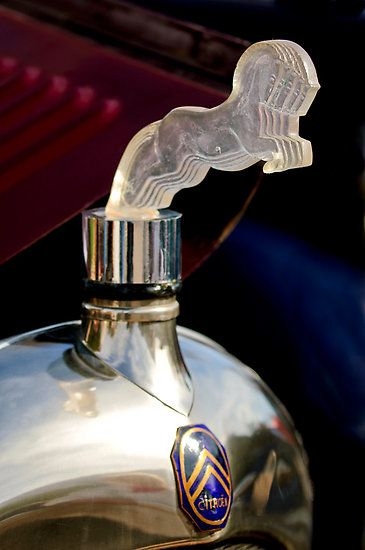
Many patented Lalique automobile radiator cap mascots were produced. A sample set of  six Lalique radiator cap mascots is posted below with the original French title of the glass sculpture in parentheses. 

The below set includes: the Citroën-commissioned 5-horsepower mascot (Cinq chevaux), the Delage Spirit of the Wind mascot (Victoire), a Rolls Royce eagle head (Tête d'aigle), the lighted Chrysis nude female (Chrysis), the dancer with raised arms (Danseuse bras levés), and the rooster head (Tête de coq). 


References
Patent FR667900, titled Bouchons lumineux pour radiateurs de voitures automobiles (Lighted caps for automobile radiators)
Lalique Museum
https://www.musee-lalique.com/en
G. G. Weiner (2014) Unique Lalique Mascots: Automotive Radiator Hood Ornaments. Illustrated Edition.  Philadelphia, PA: Trans-Atlantic Publications.

Monday, June 10, 2019

Oh, Lalique! Mascot automobile radiator caps

Copyright © Françoise Herrmann

René Lalique also became renowned for the many various automobile radiator caps (also known as "mascots"), that he designed with glass sculptures in the 1920s. Lalique automobile radiator caps were granted a French patent, but it was not the glass mascot sculptures that were patented. The invention that was patented was the actual metal cap that attaches to the car hood. It contained a socket with a small connected light bulb, which could light up the glass mascot sculpture. 

Thus, Lalique’s radiator caps were awarded the French patent FR667900, titled Bouchons lumineux pour radiateurs de voitures automobiles (Lighted caps for automobile radiators), on July 1, 1929. The title clearly designated the electrical component of the cap, even if the popularity of the caps produced resided in the many Lalique glass mascot variations that adorned the patented radiator caps on automobile hoods.

The patent recites a printed glass-cap subject (1), specifically the “Archer”, and the patented metallic means of attaching both the glass Archer (1) and cap to the automobile radiator, and lighting it. 

The metallic means comprised a cap (14) with a rim (5), connected to an upper cavity designed to house the base (11) of the glass Archer. The base (11) of the Archer was secured to the cap using an appropriate clamping nut (12) and washers (13). A socket (2) equipped with a support (3) for an electric lightbulb (4) extended through the cap, into the radiator, in such a manner that the rimmed cap, together with the socket and lightbulb, remained almost flush with the hood, without increasing the height of the mascot. A contact wire (8) exiting via a small opening (7) above the rim, was connected to the socket contact plate (9), in turn connected to the light bulb contact plate (10). The glass mascot could then be lighted, in several different colors, depending on the color of a base plate (17) placed between the base (11) of the glass mascot and the top of the light bulb. The rimmed cap (14) was screwed to the radiator via threaded sides (6), located beneath the rim (5).

The single keyed patent figure is included below, depicting a vertical sectional elevation of the cap and glass Archer embodiment of the invention. An image of the marketed and signed glass Archer sculpture is also included.


References
Lalique Museum
https://www.musee-lalique.com/en
Lalique website
https://www.lalique.com/en

Friday, June 7, 2019

Oh, Lalique! Decorated glass and crystal

Copyright © Françoise Herrmann

Renowned innovator of Art Deco jewelry, René Lalique (1860-1945) also became a master glassmaker. Initially commissioned to create perfume bottles, he went on to create monumental glass structures such as fountains, church alters, and dining room chandeliers, for example, for such luxury liners as The Normandie. René Lalique even became famous for the car radiator caps that he created out of glass.

To obtain the poetically sculpted glass pieces that are so well known, René Lalique invented a way of producing decorated glass as a single piece using a waste-mold casting process.

The French patent FR475348, titled Procédé de fabrication d’objets en verre ou cristal décoré (Process for the fabrication of decorated glass or crystal objects), granted February 16, 1915, to René Lalique, recites the waste-mold casting process used to create the signature Lalique glass or crystal pieces. A process that enables the production of glass or crystal pieces with ornamental designs that appear sculpted on their surface, displaying all the finest details of the mold. 

The patent recites a process that subsumes the application of wax or wax-type decorations on the glass or crystal surface. The glass or crystal, and its wax decorations are then cast in a mold made of a substance capable of resisting high furnace temperatures, such as a clay or clay-type mold. The clay mold, containing the wax decorated glass or crystal object, is then subjected to high furnace temperatures, causing the wax to volatilize, and the glass to soften sufficiently for it to be blown into the recesses left empty by the volatilized wax. Once cooled, the mold is then broken, and the glass or crystal piece appears with its ornamental decoration, as a single sculpted piece, that includes all the finest details of the mold.

A variation of the process is also described for cases where the ornamental design is very large, and the glass object has a large opening such as a wide-rimmed vase or bowl. In this case, the whole object with the ornamental design is made of wax, then cast in a clay-type mold. The mold is then furnace-heated to the point where the whole wax model with decorations volatilizes. The temperature of the mold is then such that molten glass might be introduced directly into the mold, where it is blown into all the recesses left empty by the volatilized wax model. Finally, once cooled, the mold is broken, and the decorated glass piece appears sculpted with all of its detailed ornaments.

The patent figure 2 is included below, depicting a narrow-rimmed glass or crystal object (1) with ornamental decorations on the surface, within a mold (2). The rim of the glass or crystal object is connected to a cane (3), through which the glass blower will blow to push the softened glass into the ornamental recesses left empty by the volatilized wax, after the mold has been heated in a furnace.

The image of one of René Lalique's famous sculpted vases, called Les Bacchantes, is also included.


References
Musée Lalique
https://www.musee-lalique.com/en

Monday, July 10, 2017

EPO Inventor Awards - The 2017 Trophy

Copyright © Françoise Herrmann

On May 11, 2017, the post at Patents on the soles of your shoes covered Murano glass and its intimate connection to the origins of patents, some 600 years ago, in the Republic Venice. This was hardly coincidental, considering that the European Inventors’ Award ceremony would be taking place the following month in Venice, Italy, and that the finalists had just been announced.

The post ended with an educated guess regarding the 2017 trophies that would be awarded to the 6 inventors (or teams of inventors). 

The design of the  EPO Inventor Award trophy represents a sail (with and without a pun), It was created by Miriam Irle, a German industrial designer. However, what also makes the design so striking and uncommon is that each year the sail trophies are crafted from a different material or process, of significance to the country hosting the awards ceremony. For example, last year, in Lisbon, Portugal, Miriam Irle selected the famous Portuguese azulejo ceramic tile for casting and production of the trophy. (Herrmann, June 10, 2016). Likewise in 2015, in Paris, France, the trophy was cast in bronze, using a 3D printing process. (Herrmann, June 13, 2015)

So, my guess for the European Inventor's Award trophy, this year in Venice, was the following:
In regards the 2017 EPO Inventor Awards…my conjecture is that the 2017 trophy will be made of Murano glass. […] Of course, I might be zapped… and completely wrong. [Herrmann, May 11, 2017]
The good news is that there was no blood shed for the guesswork…Indeed, according to the following, recently released EPO video, the 2017 European Inventor Award trophies were made of Murano glass, as predicted, on the Island of Murano, just a few nautical miles from the ancient city Venice.

References
Herrmann F. (May 11, 2017) Oh, patents! Murano glass
Miriam Irle

Thursday, May 11, 2017

Oh, patents ! Murano Glass

Copyright © Françoise Herrmann

The EPO awards ceremony will take place this year in Venice, Italy, located less than one nautical mile from the small archipelago of Murano, known for its 800-year-old glass manufacturing activity! 800 years… !

Indeed, it was in 1291 that all the Venetian glassmakers were ordered out of Venice to the small archipelago of Murano. The reasons invoked were the hazards that the furnaces used for glassblowing posed to all the wooden structures of Venice, which was also overpopulated at the time.

Until their secrets were stolen a couple centuries later, the Murano (Venetian) artisan glassmakers were the inventors and custodians of several glassmaking processes. Most importantly, the Murano glass artisans knew how to make mirrors, and they invented decorative processes involving the use of colored glass rods, such as filigrana (glass threaded with colored glass, where the color rods are stretched and fused) and millefiori (multicolored glass with “flower” designs where the color rods are cross-sectioned). Other glass processes originating in Murano included the invention of crystal (clear glass), lattimo (opaque “milk” glass), smalto (glass mosaic) and glass gemstones such as goldstone or aventurine (with a host of additional folkloric names such as monkstone, monk’s gold, stellaria and sangesetareh…)

Nowadays, the small archipelago of Murano (also called the Glass Island of Venice, even though Murano consists of 7 small islands connected by bridges) is still home to both artisan glassmakers and commercial production of glass. The oldest glassmaking company (and family), Barovier & Toso® founded in 1295, is still operating to date...with a website too! It is one of the five oldest companies in the world.

Considering that the Parte Venezia, decreed by the Republic of Venice as early as 1474, is believed to be the very first patent statute, the glassmakers of Venice (Murano) were probably among the first inventors to ever receive patent protection! In any event, the secrets of the Glassmakers’ Guilds were initially well guarded with 1295 legislation even preventing the artisans from traveling outside of the Republic of Venice, in exchange for various privileges granted to the nobility.

In a less radical mode, the 1474 Venetian patent statute required all inventors to file their inventions, and in exchange of this disclosure, granted them exclusive rights to use their inventions for a time-bound period of up to 10 years. Indeed, according to some researchers (e.g.; Feirreira Nascimiento, 2016), who have investigated early patents in Europe (France, England and Germany) and in the US, it even appears that the spirit of “recorded” innovation is strongly linked to the development of the glass industry.

Below, a copy of the 1474 Parte Venezia, containing, in a nutshell, the most essential tenets of the patenting system, as it exists to date. (A Cambridge University translation is hyperlinked in the Reference section).

File:Venetian Patent Statute 1474.png
-----
In regards the 2017 EPO Inventor Awards…my conjecture is that the 2017 trophy will be made of Murano glass. The European inventor trophy design is a “Sail” that is crafted each year from different local materials.  

Of course, I might be zapped… and completely wrong.

References
Barovier & Toso®
https://www.barovier.com/en/
Barovier & Toso® Museum
https://www.barovier.com/en/azienda/museo/
Feirreira Nascimiento, M. L.  (2016) The first patents and the rise of glass technology
Recent innovations in Chemical Engineering, 9, 1-11.
Rasmussen, S. C. (2008) Advances in 13th century glassmaking and their effect on chemical progress. Bull. Hist. Chem. 33(1), pp. 28-34.
Friday, February 10, 2017

Oh, patents! Corning® Gorilla® Glass

Copyright © Françoise Herrmann

Chances are that the glass on your tablet, smartwatch or smartphone boasts the “superior damage resistance, optical clarity and touch sensitivity” that is the stuff of Corning® Gorilla® glass!  If you are not sure, try the Corning® lookup page

Perhaps that the windshield, sunroof and dashboard on your car, might already be equipped with the latest Gorilla® glass product unveiled at CES 2017, specially designed for cars. A new Gorilla® glass product that is ever lighter, tougher and more optically advantageous to enable greater fuel efficiency, passenger safety and better performance for the driver [CES2017].

Corning® has been designing the toughest glass on earth, trademarked Gorilla® glass since the first generation of Iphones circa 2007. Since then Corning® has developed several generations of different sorts of Gorilla® glass, including:
  • Five categories of Corning® Gorilla® glass with ever higher drop protection and resistance to damage, Gorilla® Glass 5 offering the highest shoulder height drop protection on a hard surface; 
  • An antimicrobial Corning® Gorilla® glass for frequently touched public glass surfaces, that contains a built-in ionic silver component to keep the glass bacteria-free;
  • Corning® Gorilla® glass NBT™ for “touch-enabled notebooks” with increased scratch and shock resistance;
  • Large Cover Corning® Gorilla® glass for digital signage and market boards;
  • Vibrant Corning® Gorilla® glass for printing colorful designs on glass.

The following list includes some of the most recent patent applications disclosing the Corning® Gorilla® glass invention and some of its newest patentable aspects. The core of the Corning® Gorilla® glass invention is chemical strengthening of the alkali aluminosilicate glass through an ion-exchange process that forms a compressed and super hard surface armor, or layer. This layer is extremely resistant to scratching and cracking from drops or other forms of fracture, compared to other glass products on the market. Gorilla® glass is also very thin and light, ranging from 0.4 to 2 mm, and compatible with haptic feedback.
  • US2017029325 (A1) ― 2017-02-02 - Antimicrobial and strengthened glass articles through pressurized ion exchange
  • US2017022093 (A1) ― 2017-01-26 - Glass articles exhibiting improved fracture performance 
  • US2017022092 (A1) ― 2017-01-26 - Glass articles exhibiting improved fracture performance
  • US2016376186 (A1) ― 2016-12-29 - Glass with high surface strength
  • US2016376187 (A1) ― 2016-12-29 - Glass with high surface strength
  • US2016368812 (A1) ― 2016-12-22 - Strengthened glass articles and methods of making
  • US2016280591 (A1) ― 2016-09-29 - Methods for producing ion-exchanged glass and
    resulting apparatus 
And of course, no Gorilla® glass could exist without a cute gorilla to pitch the sale! 👠

  
References
Corning® Gorilla® Glass
Is it on yours?
CES 2017: Gorilla Glass is moving from Phone to automobiles. 

Wednesday, May 13, 2015

More glass magic … Philip Glass’ Glassworks

1665 Letters Patent signature page
Copyright © Françoise Herrmann

To the magic of glass...350 years ago...

-The1665 Letters Patent granted by France’s King Louis XIV for the manufacture of mirror glass, in a move to exclude competing Venitian glass makers from supplying Royal and Parisian customers.


And today...
- Dynamically tinted glass, and the Saint-Gobin patent EP0831360, titled Electrochemical device, contending for the 2015 EPO Inventor Awards, and arising in a long tradition of glass making, connected to the patented Saint–Gobain 17th century workshop that produced mirror glass for King Louis XIV’s Palace of Versailles.... 

Add Philip Glass.....and listen carefully to the sounds of Glassworks (below):


References 
Philip Glass
http://www.philipglass.com/
Glassworks
http://www.philipglass.com/music/recordings/glassworks.php

Saint-Gobain 350 – From 1665 to 2015 – The Exhibition

Sunday, May 10, 2015

2015 EPO Awards Finalist – Dynamically tintable glass


Copyright © Françoise Herrmann

Can you imagine being connected to a company celebrating 350 years of activity, founded as a secret, mirror glassmaking workshop for the King’s Palace? And then, 350 years later, can you believe the same company invented the most magical window panes on earth? There’s mystery, intrigues and a long history of glass technology at the Saint-Gobain Vitrage Company! Even the original 18th century location (in Saint-Gobain, France) and it’s buildings … are historic!

Today Saint-Gobain is a multinational enterprise, represented in more than 64 countries, with 180,000 employees and 12 research centers! The group’s activity focuses on habitat and industrial applications, and in particular, high-performance building materials serving comfort and energy efficiency.

The technology disclosed in European patent EP0831360, titled Electrochemical device, and competing as finalist in the industrial category of the 2015 EPO Inventor Awards, was developed by a Saint-Gobain subsidiary in the USA called SageGlass®

The invention pertains to dynamically tintable glass, that is, glass whose tint may be turned on or off, or automatically adjusted, according to the amount of sunlight and heat outside. The implications for energy efficiency are enormous since a whole building equipped with Sageglass® may be wired to adjust according to the external conditions of light and solar heat, without blinds, shutters or even human intervention, and thus keep the solar heat and  glare out or let it in, depending on the tint (and season).

This highly patented technology invokes clear, electrically conductive and electrochemical, nanoparticle layers applied to glass, enabling lithium ions and electrons to transfer from one layer to another, for the purposes of tinting the glass, at the flick of a switch that turns on very low voltage electricity; and for the ions and electrons to be able to back out of the layers, and reverse the glass back to clear, when the low voltage current is switched off. The process for applying the coatings is part of the invention.

Below, you will find the Abstract for EP0831360, titled Electrochemical device, and an exploded view of the invention glass and electrochemical and conductive nanoparticle layers.


In an electrochemical device having one or more substrates (1, 7), one or more electrically conductive layers (2, 6), one or more electrochemically active layers capable of reversible ion insertion (especially of H<+>, Li<+>, Na<+> and Ag<+>) and an electrolyte, the electrolyte (4) comprises one or more layers of mineral oxide-type material in which ionic conduction is created or enhanced by incorporation of hydrogen and/or nitrogen compounds, especially nitrides. Also claimed are (i) electrochromic glazing including the above device, especially having variable energy and/or light transmission, together with one or more transparent glass or plastic substrates preferably assembled as multiple or laminated glazing; (ii) energy storage elements, especially a battery, including the above device; and (iii) a gas sensor including the above device.; Further claimed is a process for making the above device, involving deposition of the hydrogen and/or nitrogen compound layer of the electrolyte by a vacuum method (cathodic sputtering, vapour deposition or plasma CVD), by a sol-gel synthesis method (especially by dipping, spray coating or laminar coating) or even by gas, powder or liquid phase pyrolysis. [EP0831360]
-----

Thus, the most magical glass on earth, now competing for the 2015 EPO Inventor awards, comes 350 years after the magic of Versailles’ Hall of Mirrors!

References
SageGlass®
http://sageglass.com/
Saint-Gobain 350 – From 1665 to 2015 – The Exhibition
http://www.saint-gobain350years.com/#!/en