Showing posts with label container. Show all posts

Thursday, September 24, 2026

Oh, patents! Driscoll's clamshell container.

 Copyright © Françoise Herrmann

Titled Clamshell raspberry container, the scope of the US patent, US9469458B2*, assigned to Driscoll Strawberry Associates Inc., extends well beyond raspberries. According to the patent, the clamshell invention extends to “such as various berries, grapes or other fruit or produce items”. Indeed, this is quite a recognizable clamshell container, at least on most of the large US supermarket displays.

Considering the notable fragility of berries and the extra careful handling they require, Driscoll’s clamshell invention was structurally designed to further protect produce during shipping and transport, and to enhance freshness. Protection was designed using a divider that both prevents the closed lid of stacked containers from collapsing and the containers from twisting or bending, which would damage the produce. Enhanced freshness involves a series of vents on the periphery of the lid and the bottom of the clamshell, essentially designed to allow air to continuously flow through, thereby keeping the produce cool in a cooled environment, while preventing the accumulation of too much condensation. Otherwise, the container snaps shut at corners, and a hinged spine connects the lid to the body on one side of the clamshell container. The preferred shape of the clamshell is rectangular, and is fabricated of molded plastic.

The patent Figure 1, included below, is a top plan perspective view of a closed stackable clamshell container, according to the invention. The Figure 1 depicts the top lid 24 perforated side vents 4, and two corner snaps 20. The top lid 24 is connected pivotally to the container with a spine 12 extending on the full length of one side. On the periphery of the container bottom 26, there are also side vents 34. In between each of the bottom vents 34, there are inwardly curved indentations 7 designed to push fruit away from the bottom vents 34, to prevent obstruction of the vents and/or laceration of the fruit. The top surface of the center divider 6 contacts the lid when it is closed to prevent collapsing and crushing of the fruit. The center divider has two lower shoulders 8, on each side of the center 6, designed to enable airflow. The extended center divider is also connected to the full height of the side walls, to strengthen the tray and prevent torsion. Additional airflow windows 2 enable air circulation above the container’s curved side walls 28.


The patent abstract is included below.
A container that includes a tray having a base bottom portion and one or more sidewalls having a volume for holding a product; a lid that is attachable to the tray to protect the product in the tray when attached thereto; and a divider for providing a plurality of compartments with a predetermined volume in the tray, the divider configured, dimensioned and positioned to provide support to the lid, air flow between the compartments and torsional rigidity to the tray. The most preferred container of the invention is a rectangular clamshell container as described herein that includes a spine which is pivotally hinged to the base bottom portion via the lid. This preferred container also includes a plurality of snap-locking members for attaching the lid to the tray for retaining contents therein. [Abstract US9469458B2]
---------
Note
*The patent was awarded to the following four California inventors: Malkeet Singh Padda (US); Craig R. Snedden (US); Gandhi B. Sifuentes (US); Cesar Ramirez (US).

Reference
Driscoll's (website)
https://www.driscolls.com/ 

Wednesday, March 30, 2022

Oh, patents! Starbucks® chewing gum tins

 Françoise © Herrmann

Starbucks® chewing gum tins were awarded the design patent USD471804, titled Chewing gum tin, on March 18, 2003.  No longer marketed, no wonder the small (1¼" x ¾" x 3⅛"), vintage, after coffee chewing gum tins have become a collector’s item on eBay, retailing for 50$ a piece, or more.

As a reminder a design patent covers the ornamental aspects of an invention, or how the invention looks. In contrast, a utility patent covers the functional and manufacturing aspects of an invention, or how the invention works (MPEP Chapt. 1502.01). 

Below, three of the patent drawings, depicting a front perspective view of the chewing gum tin design (Fig. 1), a back perspective view (Fig.2), and a front perspective view with the lid open (Fig. 3). Below the patent figure drawings of the Starbucks® chewing gum tin, an image of two, vintage, Starbucks® after coffee, chewing gum tins, respectively peppermint and cinnamon.  


References

Starbucks® Coffee Company https://www.starbucks.com/

USPTO MPEP – Chapt. 1502-01 – Distinction between design and utility patent.
https://www.uspto.gov/web/offices/pac/mpep/s1502.html

Saturday, August 10, 2019

Oh, patents! Rubbermaid® Freshworks™


Copyright © Françoise Herrmann

Keep your typically unrefrigerated produce, such as tomatoes or bananas, fresher, for longer periods of time, on the countertop. Rubbermaid® Freshworks™ containers are designed to regulate the flow of oxygen and CO2, in and out of the container, using a patented venting system in the lid, and by raising the produce from the bottom of the container, on a Crisptray, which promotes airflow and prevents spoilage. The lid filter is also designed to last a lifetime. In other words, it never has to be changed.

Time Magazine-selected as one of the best 50 inventions in 2018, Rubbermaid® Freshworks™ is an invention disclosed in the US patent application  US20190084756A1, titled  Container with gas and/or liquid permeable membrane, filed earlier this year.

The application discloses a container with an upper lid portion and a lower container portion. The lower portion is the receptacle portion for storage of fruits or vegetables. The lower portion comprises legs to elevate the container above the countertop or other surfaces, allowing airflow, and preventing any transfer of heat from the countertop or surface to the fruits or vegetables stored inside the container. The legs are also designed to facilitate stacking of the containers, one on top of the other, while providing airflow between stacked containers. The bottom interior surface of the container is dimpled, in such a way that any moisture arising from condensation is collected in the “valleys” between raised dimples, while the fruits and vegetables sit on the dimple “peaks”, instead of flat on the bottom of the container, on pooled condensation, accelerating spoilage.

The upper lid portion of the container comprises vapor and gas permeable membranes, respectively preventing excess humidity and the accumulation of gases inside the container, both of which cause spoilage of fruits and vegetables. The application further discloses various alternative aspects of the lid and receptacle portions, embodying this invention. 

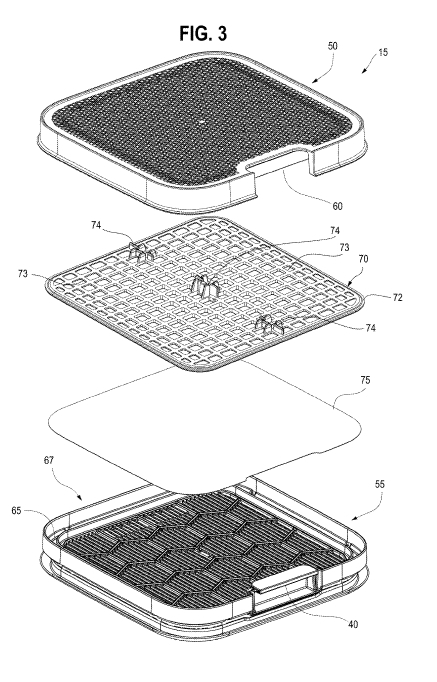
The abstract of this invention is included below, together with the exploded Figure 3 drawing of the invention lid. The exploded Figure 3 drawing shows top 50 and bottom 55 portions of the lid, together with a vapor-permeable membrane 75, regulating the humidity of the container, and a perforated sealing grid 70, designed to regulate the flow of gases within the container. The perforated sealing grid further comprises three raised standoff members 74, designed to facilitate the connection between the sealing grid 70 and the top portion 50 of the lid, which is also permeable. The figure drawing further depicts the shape and grid pattern layout of the sealing grid apertures 73. The recessed area 60 on the front of the top portion 50 of the lid is designed both to facilitate opening the lid, and to cooperate with the front handle 40 of the lower portion of the lid 55.

A food storage container is provided that may be used to increase shelf life of produce stored therein. The food storage container is preferably used to contain produce that is often not refrigerated, and thus subject to increased humidity levels when stored inside a sealed container. The container preferably includes each of a container portion and a lid member and a container portion, wherein the lid member may be attached and removed to the container portion. The lid member may include upper and lower lid members that are also selectively engageable with one another. A water vapor permeable membrane layer is preferably secured between the upper and lower lid members to help control humidity levels within the container portion. In some embodiments, a gas permeable membrane layer may be present between the upper and lower lid members for controlling gas flow into and out of the container portion as well. [Abstract US20190084756A1]
Reference
Rubbermaid®

Tuesday, March 19, 2019

Oh, patents! L'Oréal two-step mascara

Copyright © Françoise Herrmann

Washable mascara, easily removed with soap and water, has the advantage of enhancing the thickness of eyelashes. However, it is prone to running, and snudging when eyelashes are rubbed. Waterproof mascara has the advantage of being smudge-proof and water resistant, but it requires an organic solvent for removal such as a mineral oil. Prior art development in mascara consists of separately enhancing any given property of washable or waterproof mascara. A two-step mascara application aims to further improve both sorts of mascara, washable and waterproof, by combining their application. 

Thus, the purpose of this invention is to offer a two-step system of mascara application, comprising a first application of washable mascara, followed by a second application of waterproof mascara.  This two-step application of mascara is intended to enhance the thickness of real or false eyelashes, to promote greater water and smudge-resistance, and to facilitate the removal of mascara, compared to waterproof or washable mascara, used alone.

To enable the application of both sorts of mascara, the invention recites two sorts of application systems. The first system comprises a single container with two reservoirs, one reservoir for the washable mascara and another for the waterproof mascara, together with an applicator system comprising a first and second applicator for each of the different sorts of mascara. The second system comprises separate reservoirs for each of the two different sorts of mascara, together with a single applicator comprising two application members at each end, each intended for the application of one of the two different sorts of mascara.

This L’Oréal invention is recited in the US patent application US20050061348A1, titled Two-step mascara. The patent describes both of the application systems and examples of the mascara formulas for synergistic action of both waterproof and washable products. The patent also describes the performance data of the two mascaras, tested on a panel of 6 participants. The application variables evaluated included such attributes as “overall wear (judged in the number of hours, smudging/smearing, ease of application, speed of build-up, length of lashes, thickness of lashes, amount of curl, amount of spiking, amount of flaking, homogeneity of application (i.e; amount of globs or ball on lashes), softness, wetness (or lack of dryness) of appearance, time for drying, comfort, overall appearance, and ease of removal. Results reported in the patent indicate very favorable performance for all the attributes evaluated.
                                                                                  
The abstract of this invention is included below, together with two patent drawings, Figures 3A & 3B, each illustrating one of the two embodiments of the application systems. In Figure 3A, the reservoirs 14 and 16 are part of a single container. In Figure 3B the reservoirs 14 and 16 are separate, each screwed to opposite ends of a single applicator 50, comprising a handle 18 with integrated, leak-proof screw caps. The single applicator 50 also comprises two stems 22, and 24 at opposite ends, each end fitted with applicators 26 and 28.
Disclosed are methods for applying mascara compositions to eyelashes, comprising applying washable mascara followed by applying waterproof mascara. Mascara products and systems, and packages containing the products are also disclosed. [Abstract US20050061348A1] 
One of the two-step mascara invention application systems (corresponding to Fig 3B) is marketed by L’Oréal as the X-Fiber mascara with both enhanced volumizing and lengthening properties. An image of the two-step X-Fiber L’Oréal mascara application system, showing the single applicator together with its opposite stems fitted with application brushes, is also included above.

References

Wednesday, February 27, 2019

Oh, patents! The Body Shop® (1)

Copyright Françoise Herrmann

Do you shop for cruelty-free cosmetics? Are you 4ever against animal testing? Do you shop fair trade in a tradition of ethical consumerism? Do you also support human rights, advocate against human sex trafficking, and domestic violence? Do you militate against female beauty stereotypes? Are you also an AIDS-HIV activist, striving to educate youth and helping those living with AIDS and HIV?

In any one of those cases, or all of them combined, you may be shopping The Body Shop®.

The Body Shop® is the first cosmetics company to have successfully crafted its business plan based on cruelty-free natural products and an activist platform for ethical trade practices, including ethical sourcing of raw materials and local community production. Since its inception in the United Kingdom, in 1976 --the year of the worse heatwave in Europe-- the small cosmetics shop, founded by Dame Anita Roddick, has multiplied into more than 1000 Body Shops® worldwide. The small shop that first re-used its bottles and containers, is now a public company that also trades on the stock market, under the stock ticker symbol BOSB. It is the second most trusted brand in the UK. 

True to its original activism, the company has continued to launch one successful social justice campaign after another, relentlessly expanding its reach to all of the allied causes mentioned above. Most importantly, The Body Shop® keeps on selling a few classics, and an ever-changing line of fabulous natural products, ethically sourced and produced, in faraway places across the globe.  

An early invention for which The Body Shop® filed a British patent application is recited GB2293545A, titled A multiple use cosmetics device. The device disclosed in this patent is a container with two applicators on each end, designed to dispense one product with two or more applications, or two separate products, all in a single container. The preferred embodiment for this device comprises an eyeliner brush and a mascara brush, each screwed on with a cap, on each end of the dispensing body. However, the scope of this invention extends to all sorts of cosmetic products that might be conceivably applied in a 2-step process, not only for eyelashes but for lips, hair, nails, face or other parts of the body. The scope of the invention also covers a device containing one product, or two separate products housed in separate compartments of the container.

The abstract for this invention is included below, together with the three patent drawings, Figures 1, 2A and 2B.
 A multiple use cosmetics device comprises a cylindrical container (1) for a cosmetic or toiletry product or products. and at least two applicators for dispensing and applying the product or products, wherein one applicator comprises a mascara brush (26) and the other an eyeliner applicator (18). The applicators (18, 26) are secured to respective caps (15, 22) which serve to close the ends of the container (1), the caps being cylindrical and having the same diameter as the container. [Abstract GB2293545A]

Figure 1 depicts the double-barrelled container 1, with cylindrical openings (2 and 3) at each end, and necks (4 and 5).  The necks (4 and 5) have tight-fitting inner sleeves (8 and 9) and an outer threaded cover that is part of the main cylindrical body (1). The inner sleeves (8 and 9) have frusto-conical sections (11 and 12) that taper towards the inside of the container, culminating in the openings (13 and 14) for access to the cosmetic products within the container.   

Figures 2A & B depict the respective applicators that are designed to screw onto each end of Figure 1 container (1). Figure 2A depicts an eyeliner applicator with a screw cap (15). The screw cap (15) has an insert (17) with an internal thread (16) designed to cooperate with the Figure 1 container neck (4). The insert (17) has a shaft (19), attached to the eyeliner applicator (18) equipped with a frusto-conical section, at the end (20) of which the eyeliner brush (21) is secured.  Figure 2B, analogous with Figure 2A, depicts the mascara brush applicator, comprising a screw cap (22) with an insert (23) and internal thread (24), designed to cooperate with the Figure 1 container neck (5). The insert (23) has a shaft (25) ,at the end of which is attached the mascara brush (26). 

Reference
The Body Shop®
https://www.thebodyshop.com/en-us/

Thursday, December 6, 2018

Oh, patents ! Ember® Mugs

Copyright © Françoise Herrmann

Any reluctance you might have in paying $149$ for what looks like another insulated travel mug, to keep your beverage warm or cold, may vanish, once you find out just how smart the Ember® mugs can be.

Two models of the Ember® mugs are marketed: the Ember® 10 oz ceramic mugs ($80), and the Ember® 12 oz travel mugs ($149).

The Ember® mugs recharge on their coasters and are Bluetooth®-connected to an Ember® app. The Ember® app, compatible with Apple and Android devices, enables you to:
  • control the ideal temperature of your drink
  • store presets according to different sorts of beverages
  • track your consumption
  • name, or color-code, your mug
  • receive notifications for when your beverage has reached its optimum temperature
  • keep your beverage at its optimal temperature for one hour
Thus, no more cold coffee (or warm soda when cold drinkware containers are launched), Your drink will retain its ideal temperature “from the first sip to the last”!

The Ember® travel mug is a completely autonomous mug with a rotatable temperature setting dial at the base of the mug, and touch activation on the body of the mug.  Both mugs are otherwise preset to 130 degrees F. Using the app, the preset temperature setting may also be adjusted to preferred or recommended temperatures, ranging between 120 and 145 degrees F.

The visually stunning ceramic mugs come in white, black, or recently in copper. The latest equally stunning travel version of the Ember® ceramic mugs is equipped with a push-to-open, leakproof lid, offering a lip interface designed for a 360-degree sipping experience. The design of the Ember® mugs has garnered several awards such as one of Time magazine’s 25 Best inventions of the year in 2017, and an IDSA (Industrial Design Society of America) International Design Excellence Award (IDEA) in the Kitchen and Accessory category, also in 2017. 

The Ember® beverage temperature control invention is recited in the 2018 patent application, US2018084943, titled Heated or cooled drinkware. The abstract of this invention is included below together with the patent figure 1 drawing, depicting a cross-sectional view of an embodiment of the drinkware container. 
An actively heated or cooled beverage container includes a body chosen from a group consisting of a mug, a cup and a travel mug, the body having a chamber configured to receive and hold a food or beverage therein. The container has a temperature control system that includes a phase change material positioned about at least a portion of the chamber that removes heat from the beverage disposed in the chamber that has a temperature above a predetermined drinking temperature to lower the temperature of the beverage toward the predetermined drinking temperature. One or more heating elements positioned in thermal communication with a different portion of the chamber than the phase change material. The temperature control system also has control circuitry configured to control the operation of the heating element. The temperature control system also includes a ring rotatably coupled to a distal end of the body, the ring configured to rotate about a central axis of the container relative to a proximal portion of the body and to communicate with the control circuitry.
References
Internaitonal Design Excellence Awards (IDEA)
Time Magazine 25 Best Inventions in 2017

Friday, September 28, 2018

Oh, patents! Zume Pizza box

Copyright © Françoise Herrmann


The Zume Pizza Inc., pizza box was awarded the US design patent USD806575S1, titled  Food container.  Recently, the US utility patent application US20180215523A1,  titled Container for transport and storage of food products, was also filed for the Zume Pizza Inc., pizza box.

 As a reminder the difference between a utility patent and a design patent is the following:
a “utility patent” protects the way an article is used and works (35 U.S.C. 101), while a “design patent” protects the way an article looks (35 U.S.C. 171) [MPEP Chapt. 1502.01; [R-07.2015]].

The US utility patent discloses a 100% compostable, stackable and sturdy container that is used to insulate the pie, and alternatively to cook it. The container comprises a base plate and a cooperating cover. Measured against square traditional cardboard pizza boxes, the Zume Pizza Inc., pizza box addresses at least two pervasive problems of the prior art. First, the difficulty of stacking cardboard boxes in a way that prevents the cover from contacting the top of the pizza, without inserting some sort of pedestal at the center of the pie. Second, the sogginess of the pizza crust in flush contact with the base of the cardboard box, which traps all the moisture and creates condensation. 

In response to this problematic situation of the prior art, the Zume Pizza Inc.; pizza box invention comprises a domed cover, sturdy enough to stack boxes, and a rimmed base plate with a plurality of radial channels or grooves, delineating a plurality of portions (i.e. slices), each containing a sector well. Such a configuration of the base plate serves a variety of purposes. For example, the base plate configuration prevents full contact of the pizza crust with the plate, allows air to circulate beneath the crust thus providing additional insulation, alternatively allows for liquids and juices to collect and to travel away from the crust, serves as a guide for cutting or slicing the pizza into equal portions (8 in particular), adds rigidity to the base plate, and enables the base plate to be easily folded (along the channels), when it is time to compost it. 

The abstract of the US utility patent is included below, together with patent Figure 1B, showing the separated domed top cover and divided bottom plate with wells.  
Systems and methods for providing compostable food containers which preserve the quality of a food product for an extended duration of time, and which optionally allow for cooking of the food product therein. In some implementations, the food containers are sturdy, stackable, insulating, and require minimal or no manual labor to assemble. In some implementations, the food container includes a base and a cover which cooperate to form a closed chamber for supporting, protecting, insulating and optionally cooking a food product, such as a pizza. The base and cover may each be formed of a single layer of material including, but not limited to, molded sugarcane fiber (“bagasse”), molded wood fiber, molded bamboo fiber, molded paper or plastic. [Abstract US20180215523A1]

References
MPEP Chapt. 1502.01 – Definition of a Design [R-07.2015]
Zume Pizza Inc.

Saturday, January 11, 2014

Oh, patents! Jelly Belly bean container

Copyright © Françoise Herrmann


What‘s your favorite jelly bean flavor? There are 50 official flavors, plus a score of additional flavor lines, prompting the Jelly Belly Inc., company to claim:
“Jelly Belly beans expand the flavor horizons with the largest collection of flavors on the planet, each a delicious delight to the taste buds”.

The patent, USD493710, is a design patent awarded to Jelly Belly, Inc, for A jelly bean shaped container for candy. 

The container is shaped just like the world’s largest palette of jelly bean candy. It is manufactured out of tin or plastic, and comes in a many different colors and sizes - just like the candy.  Equipped with a small sliding door opening, you can use it to store all your jelly beans!